Workouts
Full Body Dumbbell Workout: 30 Minutes at Home
A 30-minute full body dumbbell workout: 6 moves in 3 rounds, with form cues, how to pick a weight, how often to train and how to progress.
RepKitchen
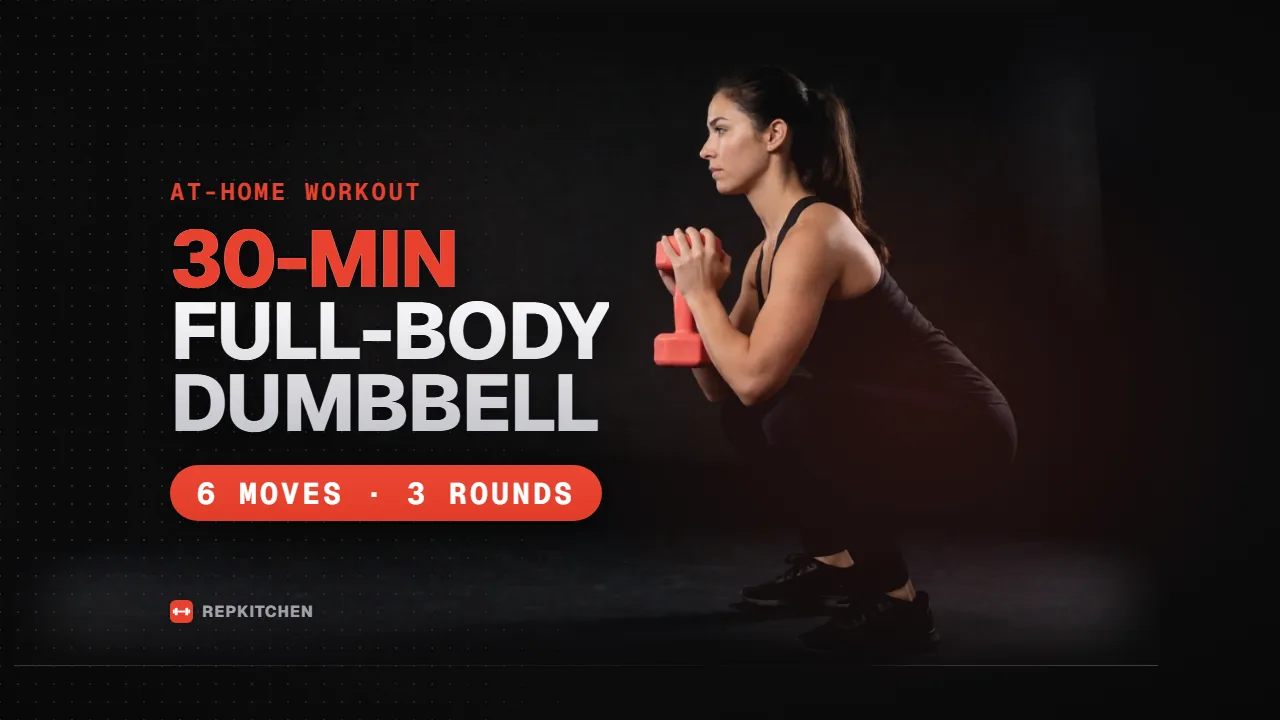
Grab your dumbbells, clear a patch of floor, and run the table below. It has a warm-up, then 3 rounds of 6 moves that cover your legs, back, chest, shoulders and core, then a short cool-down. The whole thing takes about 30 minutes. After the table you'll find how to do each move, how to pick a weight, how often to train, and how to keep it working once the early weeks are behind you.
Your 30-Minute Full-Body Dumbbell Workout
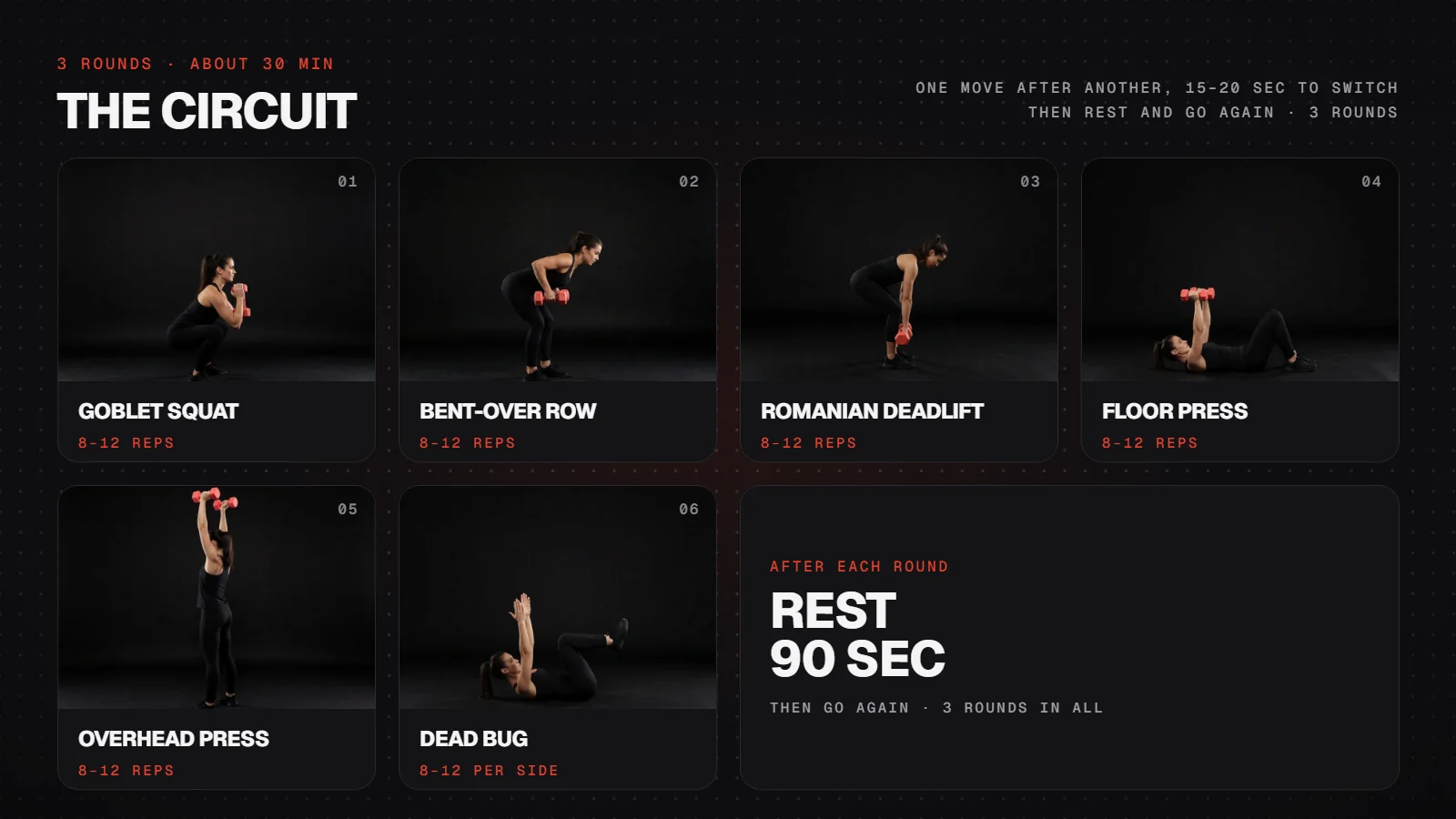
Do the moves in order, one after another, with only the time it takes to get set up between them. Rest at the end of each round, then go again.
| Part | Move | Rounds | Reps | Rest |
|---|---|---|---|---|
| Warm-up | Marching, jumping jacks, arm circles | 1 | 2-3 min total | None |
| Warm-up | Light round of the 6 moves below | 1 | 6-8 each | None |
| Circuit | 1. Goblet squat | 3 | 8-12 | 15-20 sec to switch |
| Circuit | 2. Bent-over dumbbell row | 3 | 8-12 | 15-20 sec to switch |
| Circuit | 3. Dumbbell Romanian deadlift | 3 | 8-12 | 15-20 sec to switch |
| Circuit | 4. Floor press or push-up | 3 | 8-12 | 15-20 sec to switch |
| Circuit | 5. Standing overhead press | 3 | 8-12 | 15-20 sec to switch |
| Circuit | 6. Dead bug | 3 | 8-12 per side | 90 sec after the round |
| Cool-down | Easy walking, then stretching if you like | 1 | 3-4 min | None |
Each round takes about 6 to 7 minutes, so 3 rounds plus two 90-second rests come to roughly 21 or 22 minutes. Add the warm-up and cool-down and you're at about 30.
The order matters. The big leg and back moves come first, while you're fresh, and the smaller shoulder and core work comes at the end. Between them, the 6 moves cover the four basic patterns: pushing and pulling with your legs, and pushing and pulling with your arms. The authors of ACSM's latest resistance-training position stand say those four patterns are enough to work every major muscle group.
How to Do Each Move
Learn these with a light weight before you worry about how heavy to go. Keep one breathing rule for every move: breathe out as you lift, breathe in as you lower, and don't hold your breath.
1. Goblet squat
This works your quads and glutes. Your hamstrings, inner thighs and core help out.
- Hold one dumbbell upright against your chest, both hands cupping the top end.
- Stand with your feet a little wider than your hips, toes turned out slightly.
- Sit your hips down and back, keeping your chest up and elbows pointing down.
- Go as low as you can while your heels stay flat, ideally until your elbows brush the inside of your knees.
- Push through your whole foot to stand back up.
Watch for: heels lifting or knees caving in. If either happens, don't go as deep, and push your knees out over your toes.
2. Bent-over dumbbell row
This is your main back exercise.
- Hold a dumbbell in each hand, palms facing each other.
- Soften your knees and hinge forward at the hips until your upper body is at about 45 degrees, back flat.
- Let the dumbbells hang straight down under your shoulders.
- Pull them toward your lower ribs, squeezing your shoulder blades together.
- Lower slowly until your arms are straight.
Watch for: jerking your body up to swing the weights. If your torso rises with each rep, the weight is too heavy.
3. Dumbbell Romanian deadlift
This hits your hamstrings and glutes, with your lower back, inner thighs and upper back helping out.
- Stand tall holding a dumbbell in each hand in front of your thighs.
- Unlock your knees slightly and keep them at that bend the whole time.
- Push your hips back like you're closing a car door with your butt, sliding the dumbbells down the front of your legs.
- Stop when you feel a strong stretch in your hamstrings, usually somewhere around mid-shin.
- Drive your hips forward to stand back up, squeezing your glutes at the top.
Watch for: your back rounding at the bottom. Keep your chest proud, and stop the descent wherever your back starts to curve.
4. Floor press or push-up
Floor press:
- Lie on your back with your knees bent and your feet flat.
- Hold a dumbbell in each hand above your chest, arms straight, palms facing your feet.
- Lower the weights until your upper arms touch the floor, elbows at about 45 degrees from your body.
- Pause for a moment, then press back up.
Push-up: hands just wider than your shoulders, body in one straight line from head to heels, chest down toward the floor, then push away. It works your chest and triceps, with your front shoulders and core helping. Drop to your knees or put your hands on a sturdy chair if full push-ups are too hard for 8 reps.
Watch for: elbows flaring straight out to the sides. Tuck them in a bit, which is easier on your shoulders.
5. Standing overhead press
- Stand with your feet hip-width apart, a dumbbell in each hand at shoulder height, palms facing forward or toward each other.
- Squeeze your glutes and brace your stomach like you're about to be poked.
- Press the dumbbells straight up until your arms are straight overhead.
- Lower them slowly back to your shoulders.
Watch for: leaning back to get the weight up. If your lower back arches, go lighter.
6. Dead bug
This works the muscles at the front of your stomach, with your obliques helping.
- Lie on your back with your arms pointing at the ceiling and your knees bent at 90 degrees over your hips.
- Press your lower back flat into the floor.
- Slowly lower your right arm behind your head and your left leg toward the floor at the same time.
- Stop just before your back starts to lift, then bring both back to the start.
- Switch sides. Each side counts as 1 rep.
Watch for: your lower back peeling off the floor. That's the whole point of the exercise, so make the reach shorter if you need to.
Circuit or Straight Sets?
Straight sets mean doing all 3 sets of squats, then all 3 sets of rows, and so on. A circuit means doing one set of each move in turn, then repeating the round.
Both work. If you're short on time, do the circuit. Moving from squats to rows lets your legs rest while your back works, so you get through the same amount of lifting in less time. ACSM's 2026 position stand found that rest periods under 1 minute and over 1 minute gave similar strength gains, and it lists circuit training and home training among the approaches that improve strength. You don't have to sit around for 2 or 3 minutes between sets to get stronger.
Pick straight sets if you have more time and want to focus on one move, or if you're sharing the space and can't keep switching. Otherwise, the circuit is the better choice for a 30-minute home session.
What You Need (and the One-Dumbbell Version)
One pair of dumbbells covers everything in this workout. A mat makes the floor press and dead bug more comfortable, and a sturdy chair or bench is handy for easier push-ups or for leaning on during one-arm rows.
Adjustable dumbbells are the most useful buy, because your legs and back will want more weight than your shoulders. If you have fixed dumbbells, a lighter pair for pressing and a heavier pair for squats and deadlifts is ideal, but one pair still works with the tricks in the weight section below.
The one-dumbbell version
With just one dumbbell, every move still works:
- Goblet squat: no change; it already uses one.
- Row: do it one arm at a time with your free hand on a chair. Do all your reps on one side, then switch.
- Romanian deadlift: hold the single dumbbell by both ends in front of your thighs.
- Floor press: press one arm at a time, or swap to push-ups.
- Overhead press: one arm at a time, with your other hand on your hip.
- Dead bug: no weight needed.
The one-arm moves take a bit longer, so a round might stretch to 8 minutes. If that pushes you past 30 minutes, cut the rest between rounds to 60 seconds.
How to Warm Up Before You Lift
Spend 5 to 6 minutes on this. It's short, and it gets your body ready for the work.
- 2 to 3 minutes of easy movement: march in place, then do some jumping jacks, arm circles forward and back, and a few bodyweight squats. You want to feel warm, not tired.
- 1 light round of the circuit: do 6 to 8 reps of each move with no weight or a weight much lighter than your working weight. This doubles as a form check.
Save long, held stretches for afterward. Stretching before lifting can reduce your strength and power for the session, while a moving, cardio-style warm-up like this one helps your lifting more. If you want more ideas for warm-up drills that match what you're about to do, ACE has a guide to designing activity-specific warm-ups and mobility drills.
A warm-up and gradual build-up seem to help keep you from getting hurt, but that hasn't been proven. The light round mostly pays off by making your first working set feel smoother.
How to Choose Your Starting Weight
You don't need to test your max. Use one rule: pick a weight where the last of your 8 to 12 reps is hard and another rep would be difficult, but your form still looks clean. You should feel your muscles working hard, but you shouldn't be straining, grinding or twisting to finish.
Expect different weights for different moves. Squats, Romanian deadlifts and rows usually take a heavier dumbbell than presses.
Example: finding your weights on day 1
Say you start the goblet squat with a 20 lb dumbbell and knock out 15 reps without much effort. That's too light. Next session, try 25 or 30 lb.
On the overhead press, you try a pair of 10 lb dumbbells. By rep 10 your arms are slowing down and an 11th rep would be a fight. That's your starting weight.
Write these down. A note on your phone with each move and its weight saves you guessing next time.
Making a light pair harder
If your only dumbbells are too light for squats or deadlifts, you can make the same weight harder:
- Lower slowly: take 3 to 4 seconds on the way down.
- Pause: hold for 2 seconds at the bottom of the squat or the stretch of the deadlift.
- Do more reps: go past 12 until you reach that "one more would be difficult" point.
How Many Days a Week to Train
Do this workout 2 or 3 days a week, with at least a day off between sessions. That gives your muscles 48 to 72 hours to recover, which is the usual advice for lifting the same muscles again.
A simple week looks like this:
- Monday: workout
- Tuesday: walk
- Wednesday: workout
- Thursday: walk
- Friday: workout
- Weekend: walk, rest or whatever you enjoy
If 3 days doesn't fit, Monday and Thursday works fine. The US activity guidelines call for muscle-strengthening work on 2 or more days a week, covering the legs, hips, back, abdomen, chest, shoulders and arms. This workout hits all of them.
If you haven't been active for a while, start with 1 day a week at a comfortable effort, then build up to 2 days over a few weeks. There's no rush.
The same guidelines also suggest 150 to 300 minutes a week of moderate cardio, like a brisk walk. A 25- to 30-minute walk on your non-lifting days gets you most of the way there.
How to Progress So It Still Works in Week 8
For the first few weeks, just show up. Going from no lifting to some lifting is the biggest jump you'll ever make, and you don't need to add weight to see early benefits. After that, you'll need to keep making the work a bit harder to keep improving.
When to go heavier
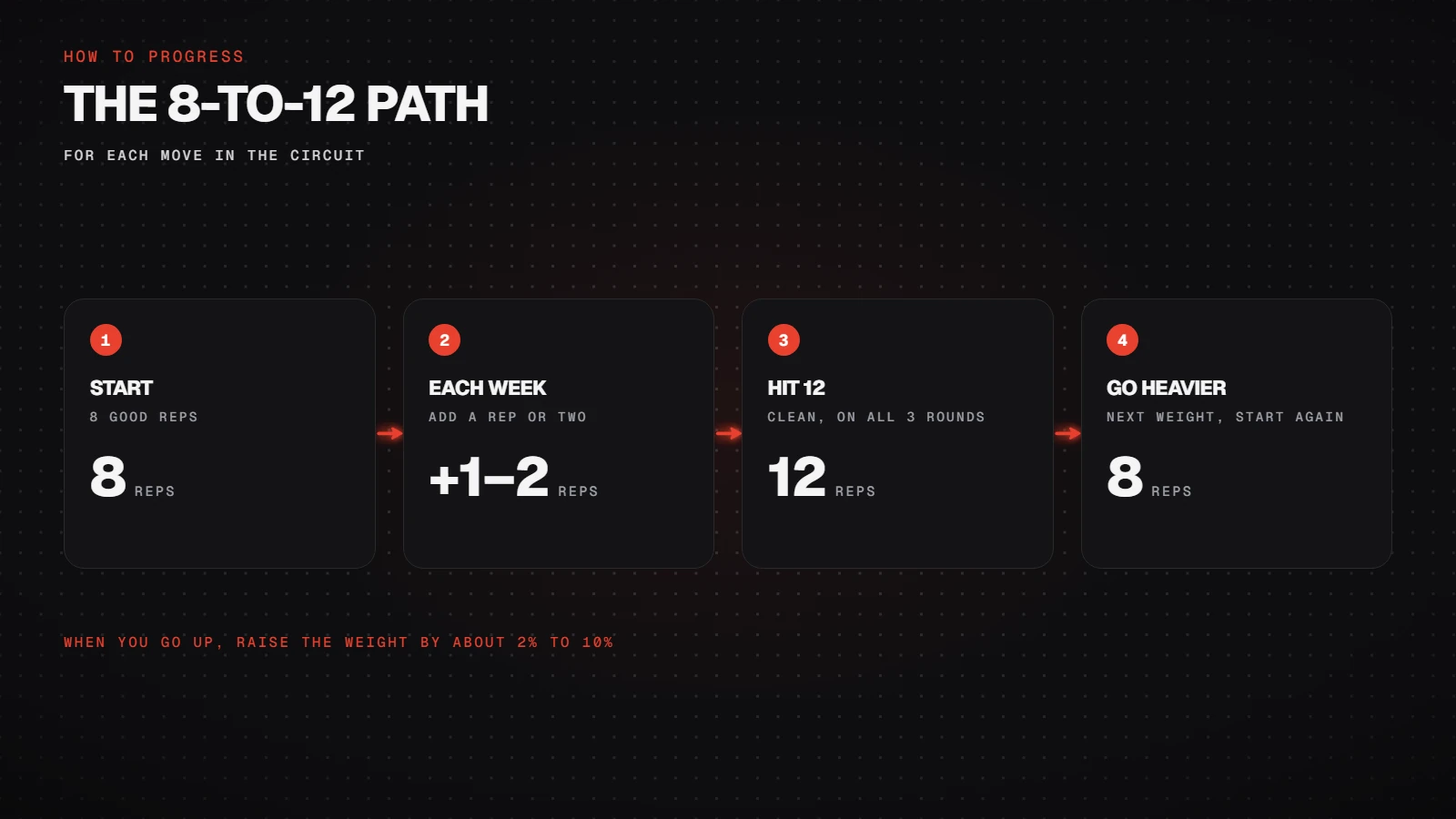
Once you can do 1 or 2 reps more than your target with good form, it's time to go up. A good rule is to raise the weight by about 2% to 10%.
With dumbbells, that usually means the next step up. On a 25 lb dumbbell, 10% is 2.5 lb. On a 40 lb dumbbell, it's 4 lb, so a 5 lb jump is about right. Lower-body moves can usually handle the bigger jumps sooner than presses can.
The 8-to-12 path
This is the simplest way to run it:
- Start each move at a weight you can lift for 8 good reps.
- Each week, try to add a rep or two.
- When you hit 12 clean reps on all 3 rounds, go up to the next weight.
- Drop back to 8 reps with the new weight and climb again.
For more ways to build up over the months, the HPRC has guidelines for progressing your training over time.
When your fixed pair gets too easy
A fixed pair can't go up in small steps, so you'll need other ways to make the work harder before buying heavier dumbbells:
- Add a 4th round. This adds about 6 minutes, so your session runs closer to 36.
- Slow down the lowering to 3 or 4 seconds per rep.
- Use a harder variation. Raise your feet on a chair for push-ups, or do Romanian deadlifts on one leg.
- Go one arm or one leg at a time. A one-arm press with a 15 lb dumbbell feels much heavier than pressing a pair of them together.
Once even these feel easy at 12 or more reps, it's time for heavier dumbbells, at least for your legs and back.
Can a Full Body Dumbbell Workout in 30 Minutes Build Strength?
Yes, it covers what's been tied to strength gains. No one can promise how much muscle or strength you'll gain, since that depends on you, your food, your sleep and how consistent you are.
Look at what you're doing each week. Every move gets 3 sets per session. At 3 sessions a week, that's 9 sets per move, or 6 sets at 2 sessions. Some muscles get extra work from more than one move: your glutes work in both the squat and the deadlift, your back in both the row and the deadlift, and your triceps in both presses. That pushes several muscle groups past 10 sets a week.
ACSM's 2026 position stand on resistance training links 2 to 3 sets per exercise with strength gains and about 10 or more weekly sets per muscle group with more muscle growth. Extra sets give less and less back after about 2 to 3 per exercise for strength, and about 18 to 20 a week for size. A 30-minute session lands right in that useful range.
You also don't need to go to failure, where you can't lift the weight one more time. Training to failure didn't consistently change results. Stop when the next rep would be a struggle or your form would start to slip. You'll recover faster, and you'll still be keen to train on Wednesday.
Optional Add-Ons If You Have Extra Time
If you finish the circuit and still have 5 to 10 minutes and some energy left, add 2 or 3 rounds of one or two of these. Do them after the main circuit so they don't take anything away from the big moves.
- Reverse lunges: 8 to 10 per leg. Step back, lower until your back knee nearly touches the floor, then push back up.
- Biceps curls: 10 to 12 reps. Keep your elbows pinned to your sides.
- Overhead triceps extension: 10 to 12 reps. Hold one dumbbell with both hands behind your head and straighten your arms toward the ceiling.
These are extras. The 30-minute session already covers your whole body without them.
FAQ
Can I do this workout every day?
It's better not to. Your muscles need 48 to 72 hours between sessions to recover, so 2 or 3 days a week with walking in between works better than daily lifting.
What dumbbells should a beginner buy?
An adjustable pair is the best value, because you'll need a heavier weight for squats and deadlifts than for presses. If you go fixed, get a lighter pair for pressing and a heavier pair, or a single heavier dumbbell, for goblet squats and deadlifts.
Should I do cardio on the same day?
You can. A walk after the workout is fine. If you want hard cardio and lifting on the same day, lift first so you're fresh for the dumbbells, or do them at different times of day.
How long until I should change the workout?
As long as you're still adding reps or weight, stick with it. Swap a move for a similar one (reverse lunges for goblet squats, say) once you've stopped progressing on it for a few weeks, or if you're bored and starting to skip sessions.