Meal Prep
Baked Turkey Meatballs: 5 High-Protein Meal Prep Lunches
Baked turkey meatballs take 15-25 minutes at 400°F and are done at 165°F. Get a 2 lb batch for 5 lunches with 49 g protein each, storage and reheating.
RepKitchen
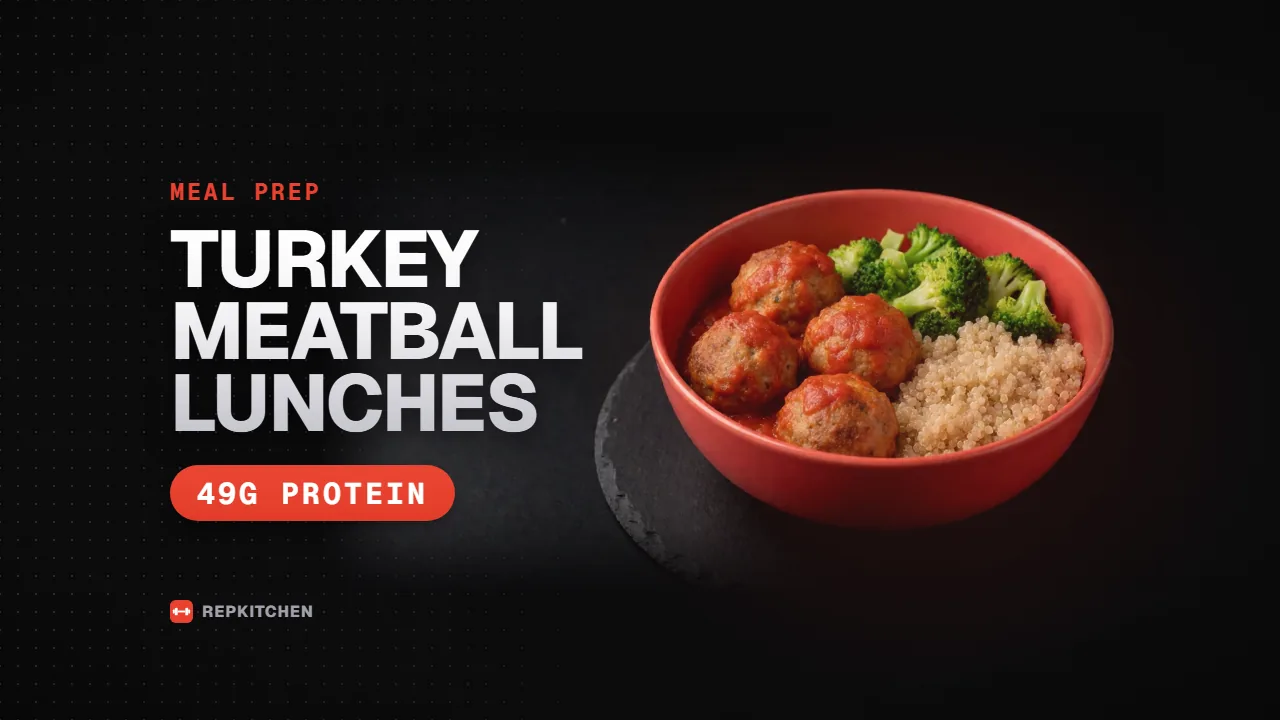
Bake turkey meatballs at 400°F for about 15 to 25 minutes, depending on how big you roll them. Smaller meatballs land near the shorter end. They're done when the center of the thickest one reads 165°F on an instant-read thermometer. Below you'll find a 2 lb batch that becomes 5 high-protein lunches, how to split them between fridge and freezer, and the calories and protein for each lunch.
Oven temp, bake time and how to tell they're done
Use 400°F. It's hot enough to brown the outside before the inside dries out, and it's quick enough that you're not waiting around on a Sunday.
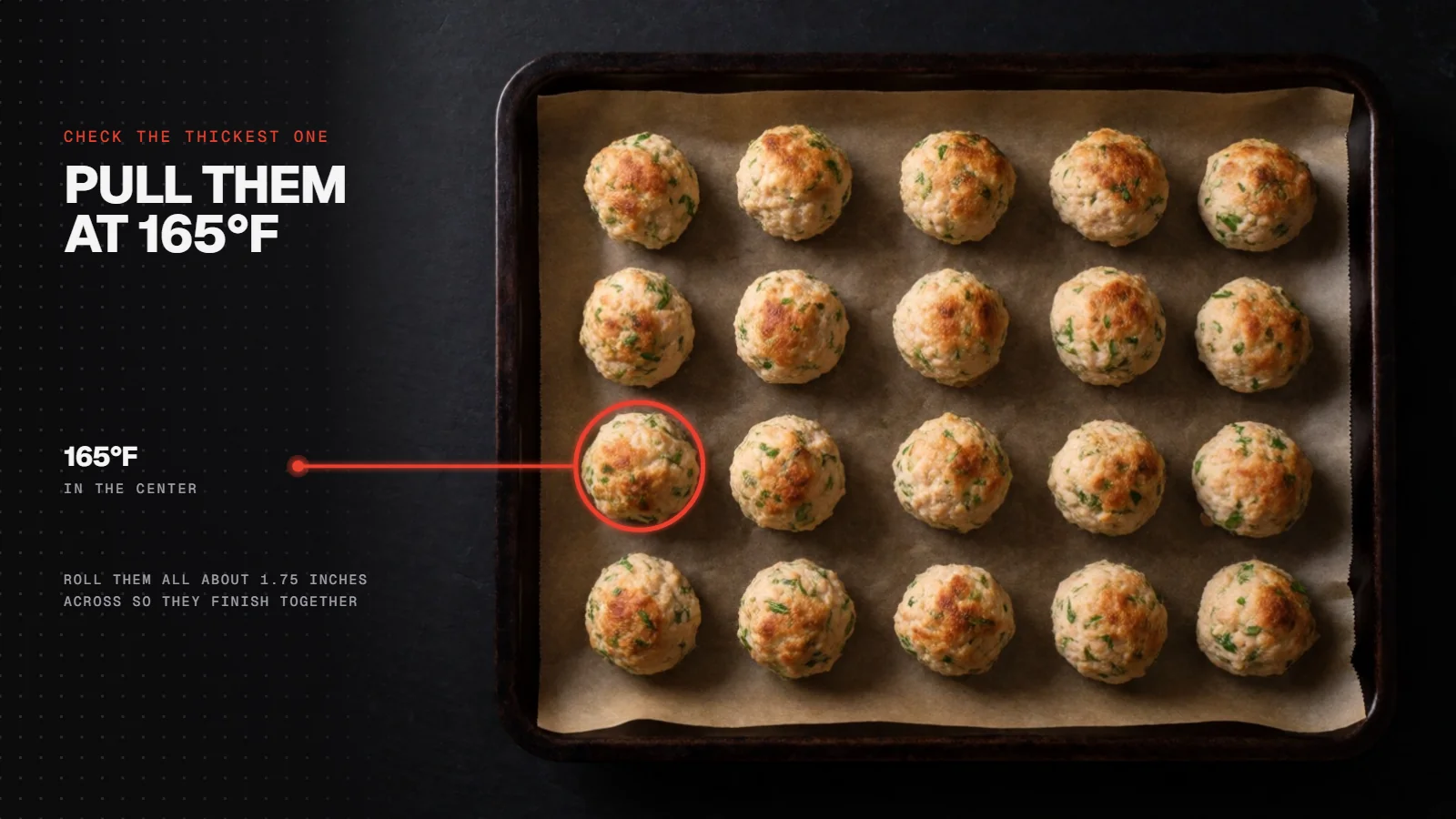
Treat 15 to 25 minutes as a starting point. Your oven, your pan and how big you roll the meatballs all change the timing. The real test is the thermometer. Ground turkey is poultry, so it needs to hit 165°F in the center. That's higher than the 160°F you'd use for beef or pork meatballs.
You can't judge turkey by eye. A meatball that looks white all the way through can still be under temperature, and one with a faint pink tinge can be fully cooked. The thermometer settles it.
It also keeps them juicy. Most dry turkey meatballs are just overcooked ones. If you start checking at 15 minutes and pull the tray the moment the thickest meatball reads 165°F, you won't overcook them.
How to make baked turkey meatballs that stay juicy
This batch makes about 20 to 24 meatballs, so 4 to 5 per lunch.
Ingredients (makes 5 lunches)
Meatballs
- 2 lb (906 g) ground turkey, 93% lean
- 1 large egg (50 g)
- 1/2 cup (54 g) plain dry breadcrumbs
- 1/4 cup (4 tbsp, 30 g) grated Parmesan
- 3 garlic cloves, minced
- 1/4 cup chopped fresh parsley
- 1 tsp salt
- 1/2 tsp black pepper
- 1 tbsp (13.5 g) olive oil, for brushing
For each lunch
- 1/2 cup (132 g) marinara
- 3/4 cup (139 g) cooked quinoa
- 1 cup (91 g) chopped broccoli, steamed or roasted
What each ingredient does
- Turkey: the protein. 93% lean has enough fat to stay tender.
- Egg: binds everything so the meatballs hold their shape.
- Breadcrumbs: soak up the juices as the meat cooks and hold them inside. This is your best defense against dryness.
- Parmesan: salty, savory flavor, plus a little extra protein.
- Garlic, parsley, salt, pepper: turkey is mild, so it needs the seasoning. These add almost no calories.
If you'd rather use panko, go ahead. The nutrition numbers below are based on plain dry breadcrumbs.
Steps
- Heat the oven to 400°F. Line a large rimmed baking sheet with parchment or foil.
- In a big bowl, beat the egg. Stir in the breadcrumbs, Parmesan, garlic, parsley, salt and pepper. Let it sit for 2 minutes so the crumbs soften.
- Add the turkey. Mix with your hands just until everything is evenly combined, about 30 to 60 seconds.
- Wet your fingertips and roll the mixture into balls about 1.75 inches across. Set them on the pan, not touching.
- Brush or spray the meatballs with the olive oil.
- Bake for 15 minutes, then check the thickest meatball with a thermometer.
- If it's under 165°F, bake for 2 to 3 more minutes and check again. Keep going until it reads 165°F.
- Take the pan out and let the meatballs rest for 5 minutes before packing.
Cook the quinoa and broccoli while the meatballs bake, and warm the marinara if you like it hot going in.
Why turkey meatballs dry out and how to stop it
Turkey has less fat than beef, so it's less forgiving. Five habits make most of the difference.
Buy 93% lean, not fat-free
Fat-free turkey has almost no fat to keep it moist, and it bakes up firm and crumbly. The extra few grams of fat in 93% lean are what make the meatball tender. More on the numbers in the swaps section.
Mix gently
Overworking the meat makes it tight and bouncy, like a sausage. Stop as soon as you can't see streaks of breadcrumb or loose egg. Some unevenness is fine.
Keep the breadcrumbs
People cut them to save carbs and then wonder why the meatballs are dry. The crumbs hold the juices in. Split across the batch, they add about 8 g of carbs per lunch, which is a small cost for a much better meatball.
Pull them at 165°F
"A few extra minutes to be safe" is how most turkey meatballs dry out. Once the thickest one hits 165°F, they're safe. Extra time only cooks off moisture.
Roll them all the same size
If half are 1 inch and half are 2 inches, the small ones overcook while you wait for the big ones. A cookie scoop helps, or roll one, eyeball it, and match the rest to it. Wet fingertips keep the mix from sticking, so you can roll quickly without squashing them.
Handling raw turkey safely
A few quick kitchen rules while you're working with the raw mix:
- Use a separate cutting board for raw turkey, and keep it and its juices away from anything you'll eat without cooking, like the parsley once it's chopped or the cooked quinoa.
- Wash your hands with soap and water for at least 20 seconds after touching raw turkey or the egg. Do it before you grab the oil brush or the fridge handle.
- Buy the turkey close to prep day. Raw ground turkey only keeps 1 to 2 days in the fridge. If you shop on Wednesday for a Sunday prep, freeze it when you get home.
- Thaw frozen turkey safely. Use the fridge, cold water or the microwave, never the counter. If you thaw it in cold water or the microwave, cook it right away.
The fridge is the easiest option. Move the package to the fridge a day or so ahead and it's ready when you are.
Packing the batch into 5 lunches
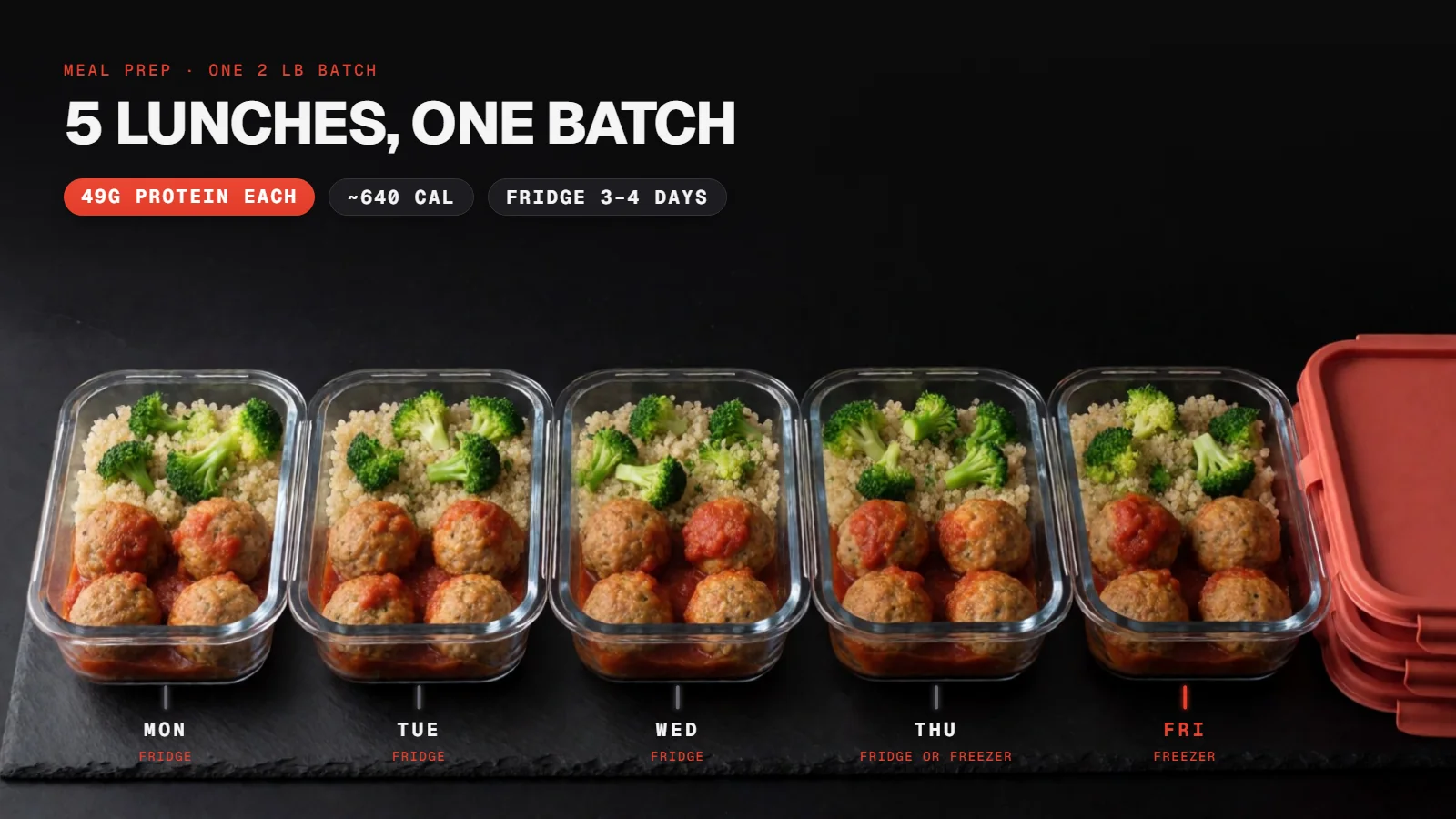
Once the meatballs have rested, divide them into 5 containers, about 4 to 5 meatballs each. That's roughly 135 g of cooked turkey per lunch, a little under 5 oz. Add the quinoa, broccoli and marinara.
Cool them fast
Get every container into the fridge or freezer within 2 hours of cooking, or within 1 hour if your kitchen is above 90°F. Lunch-sized containers are shallow, so they cool quickly, and small portions like these can go straight into the fridge while still warm. Don't let the whole tray sit on the counter while you do the dishes.
Fridge or freezer
Cooked leftovers keep 3 to 4 days in the fridge, which is the guidance in the FDA's food safety tips. Five lunches won't all make it to Friday, so split them on prep day:
- Fridge: Monday, Tuesday and Wednesday. If you prep on Sunday, Thursday's lunch can go in the fridge too, since it's day 4.
- Freezer: Friday's lunch, plus Thursday's if you'd rather play it safe.
Your fridge should be at 40°F or below and your freezer at 0°F or below. A cheap appliance thermometer will tell you, and the FDA's page on refrigerator thermometers explains why it matters.
Frozen lunches taste best within 2 to 6 months. They stay safe as long as they're kept at 0°F, but the texture slowly gets worse.
Freezing extra meatballs on their own
If you make a double batch, freeze the spare meatballs loose. Spread them on a lined tray, freeze until firm, then bag them. They won't stick together, so you can grab 4 or 5 at a time. Freeze them cooked rather than raw. For meal prep, that means the work is already done.
Calories and protein per lunch
Here's one lunch, worked out from the amounts in the recipe.
| Part of the lunch | Amount | Calories | Protein | Carbs | Fat |
|---|---|---|---|---|---|
| Meatballs | 1/5 of the batch | 378 | 38.4 g | 8.6 g | 21.1 g |
| Marinara | 1/2 cup (132 g) | 66 | 1.8 g | 9.8 g | 2.1 g |
| Quinoa, cooked | 3/4 cup (139 g) | 167 | 6.1 g | 29.6 g | 2.7 g |
| Broccoli | 1 cup (91 g raw) | 31 | 2.6 g | 6.0 g | 0.3 g |
| Total | about 640 | about 49 g | about 54 g | about 26 g |
A few notes on the numbers:
- The oil is counted in full. Some of that tablespoon stays on the pan, so the real number is probably a little lower. Logging all of it is the honest way to do it, and it's only about 24 calories per lunch.
- "93% lean" is a rounded label. It doesn't mean exactly 7% fat by weight. USDA measured 8.34 g of fat per 100 g of raw 93% lean turkey in one dataset and 9.59 g in a newer one. The table uses the 8.34 g figure, so your brand may come out a few grams of fat higher.
- The meatballs carry the protein. About 38 of the 49 grams come from them. The rest is a bonus from the sides.
What does 49 g mean for you? Say you've set yourself a goal of 140 g of protein a day. One lunch covers about a third of it. Add a solid breakfast and dinner and you're most of the way there without much effort.
Reheating from the fridge or the freezer
Whichever container you grab, the goal is the same: hot all the way through, 165°F in the center of a meatball.
Thawing a frozen lunch
The night before, move the container from the freezer to the fridge. By lunchtime it'll be thawed and ready to reheat like the others. If you forget, you can thaw it in the microwave on the defrost setting, but then reheat it straight away. Never leave it on the counter or in your bag to thaw.
In the microwave
- Loosen the lid or cover the container with a microwave-safe cover, so steam keeps everything moist.
- Heat for 90 seconds.
- Stir the sauce and turn the meatballs over.
- Rotate the container if your microwave doesn't have a turntable, then heat for another 60 to 90 seconds.
- Let it stand for 1 minute so the heat evens out.
- Check the center of a meatball. If it's under 165°F, heat it in 30-second bursts until it's there.
Meatballs heat more slowly than the quinoa around them, so stirring and turning them matters. The edges of the container will be steaming long before the middle of a meatball is hot.
On the stove, in sauce
If you're home, tip the meatballs and marinara into a small pan, cover, and heat until the sauce comes to a boil. Lower the heat and simmer, turning the meatballs, until they reach 165°F inside. This is the best way to reheat them. The sauce keeps them moist and they taste almost fresh.
Swaps worth making and ones to skip
The recipe contains egg, milk (the Parmesan) and wheat (the breadcrumbs). Any swap you make for allergies or taste will change the numbers, so here's how the common ones shake out per lunch.
| Lunch version | Calories | Protein | Carbs | Fat |
|---|---|---|---|---|
| Recipe as written | about 640 | about 49 g | about 54 g | about 26 g |
| Fat-free turkey | about 575 | about 58 g | about 54 g | about 15 g |
| 85% lean turkey | about 695 | about 46 g | about 54 g | about 34 g |
| Brown rice (3/4 cup) instead of quinoa | about 660 | about 47 g | about 63 g | about 25 g |
| White rice (3/4 cup) instead of quinoa | about 630 | about 46 g | about 58 g | about 24 g |
| No grain | about 475 | about 43 g | about 24 g | about 23 g |
| No marinara | about 575 | about 47 g | about 44 g | about 24 g |
Fat-free turkey: skip it
The numbers look great, with more protein and less fat. But the meatballs come out dry and dense, and by day 3 they're rough to eat. If you want to cut fat, drop the grain or the sauce instead. Your lunch will taste much better.
85% lean turkey: fine if you like it richer
It makes a juicier, more forgiving meatball. You trade about 3 g of protein for about 8 g more fat per lunch. It's a good pick if you've had trouble with dry meatballs and don't mind the extra calories.
Rice instead of quinoa: your call
Brown and white rice both work, and both reheat well. Quinoa gives you a couple more grams of protein. Pick whichever you'll look forward to eating.
Skipping the grain or sauce
Dropping the grain makes a lighter lunch that's still high in protein. Skipping the sauce is fine if you'll eat the meatballs cold or with a dip, but the marinara is what keeps them moist when you reheat. If you microwave your lunch, keep the sauce.
Low-carb binders
You can leave out the breadcrumbs, or both the egg and the breadcrumbs. The meatballs will be softer, harder to roll and more likely to fall apart, and they lose some of their juiciness. It works, but the original holds up better through the week. The macros will change, so work them out from whatever you use.
Stuffed or herb-heavy versions
Pressing a small cube of mozzarella into the center of each meatball before rolling makes a nice change, but it adds fat and calories, so count the cheese. Doubling the parsley and adding basil or oregano costs you nothing and wakes up a plain batch.
FAQ
Why 165°F and not 160°F like beef meatballs?
Turkey is poultry, and poultry needs a higher internal temperature to be safe. Beef and pork meatballs are done at 160°F, but ground turkey needs 165°F. Reheated leftovers should also reach 165°F, whatever the meat.
Can I keep all 5 lunches in the fridge?
No. Cooked leftovers keep 3 to 4 days in the fridge, so Friday's lunch would be past that. Freeze it on prep day and move it to the fridge Thursday night.
Are fat-free turkey meatballs worth it?
Not really. You gain about 9 g of protein per lunch, but the meatballs are dry and crumbly, especially after a few days. 93% lean is the better choice.
How do I reheat a frozen lunch at work?
Thaw it in the fridge overnight, then microwave it covered, stirring and turning the meatballs halfway, and let it stand for a minute. If you forgot to thaw it, use the defrost setting and then heat it right away. Either way, make sure the center of a meatball hits 165°F.
Can I bake the meatballs from raw-frozen?
You can bake meatballs you froze raw, but it takes longer and the timing varies. Bake them at 400°F until the center of the thickest one reads 165°F. For meal prep, freezing them cooked is simpler.