Nutrition
How to Calculate Macros in 4 Simple Steps
How to calculate macros: estimate calories with Mifflin-St Jeor (not Harris-Benedict), adjust for your goal, set protein in g/kg, then split fat and carbs.
RepKitchen
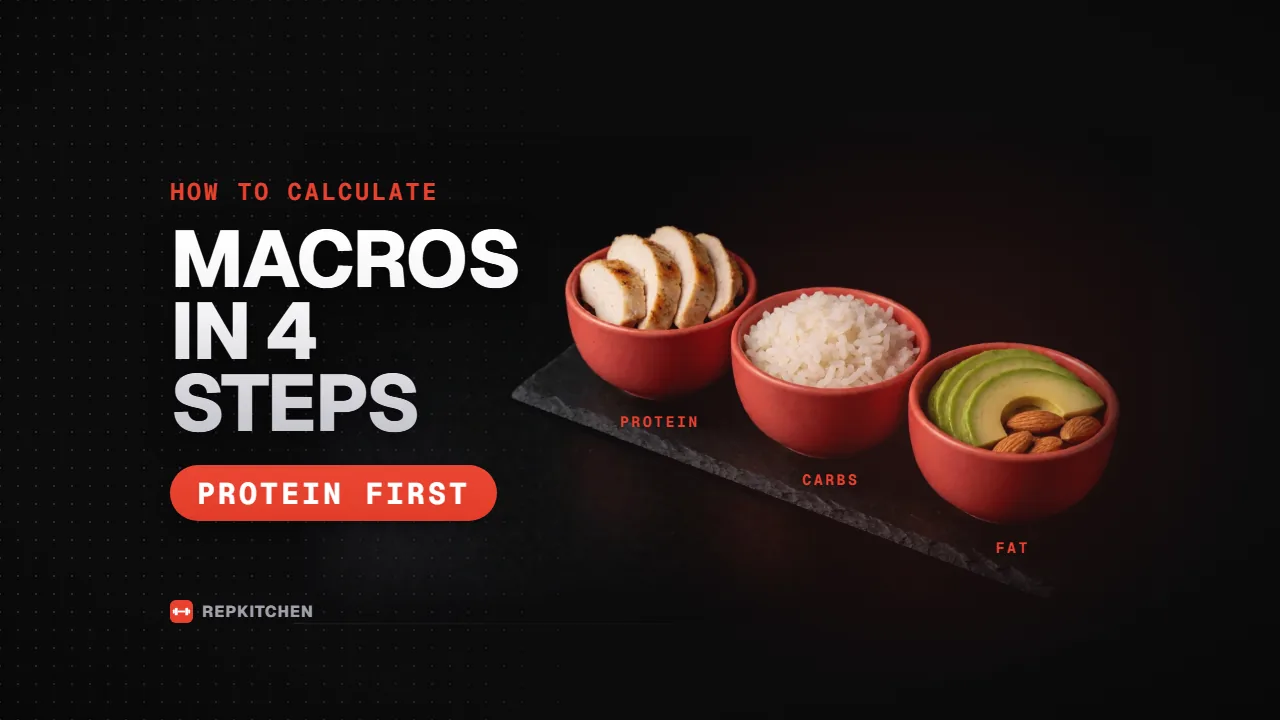
Calculating macros comes down to a little arithmetic. You turn your body stats into a calorie estimate, adjust it for your goal, then divide those calories into grams of protein, fat and carbs. Once you've done it by hand, you can redo it any time your weight or training changes.
How to calculate macros in 4 steps
- Estimate your resting calories with the Mifflin-St Jeor equation, using your weight, height, age and sex.
- Multiply by your activity level (called PAL) to estimate how many calories you burn in a full day.
- Adjust for your goal. Subtract a moderate amount to lose fat, add a little to gain, or leave it alone to maintain.
- Set protein in grams per kilogram of body weight, then split the calories that are left between fat and carbs.
Each step below explains what to do and why it works. We'll follow one made-up person through all four steps so you can check every line of the math.
What macros are and how many calories each gram holds
Macronutrients, or macros, are the three nutrients that supply most of your calories: carbohydrate, fat and protein. Each one has its own official intake range, which we'll use later to check the result.
The "calorie" on a food label is a kilocalorie (kcal), sometimes called a kilogram calorie. When a label says 200 calories, it means 200 kcal. In this article the two words mean the same thing.
Every step from here on relies on how many calories one gram of each macro provides:
- Protein: 4 kcal per gram
- Carbohydrate: 4 kcal per gram
- Fat: 9 kcal per gram
This is often called the 4-4-9 rule. It lets you convert in either direction: 30 g of protein is 120 kcal, and 450 kcal of fat is 50 g.
Why a label won't always match your 4-4-9 math
US food labels may calculate calories with these general factors or with factors specific to that food. So if you add up the macros on a package, you may land a few calories away from the printed total. Raw boneless, skinless chicken breast is a good example. Per 100 g it has 22.5 g protein, 1.93 g fat and no carbs. That comes to 106 kcal with the general factors and 112 kcal with food-specific ones. Neither number is wrong, and a gap that small won't throw off your tracking.
Step 1: Estimate your resting calories with Mifflin-St Jeor
Resting energy expenditure (REE) is the number of calories your body burns at rest, just to keep you running. It's the baseline that every other step builds on.
The Mifflin-St Jeor equation estimates it from four inputs. The equation uses metric units, so convert first:
- Weight: pounds × 0.4535924 = kilograms
- Height: inches × 2.54 = centimeters
Then use the version for your sex:
- Men: 10 × weight (kg) + 6.25 × height (cm) − 5 × age (years) + 5
- Women: 10 × weight (kg) + 6.25 × height (cm) − 5 × age (years) − 161
The constant at the end is the only part that differs between the two versions, so take care to use the right one.
This equation is the usual pick because of how it was built. It comes from a 1990 study of 498 healthy adults aged 19 to 78, including both normal-weight and obese people. In that same study, the older Harris-Benedict equations from 1919 overestimated measured resting calories by about 5%.
Example: her resting calories
Our example person is a 30-year-old woman who weighs 150 lb and is 5 ft 5 in tall. She works a desk job, lifts weights 3 to 4 times a week, and wants to lose fat.
- Weight: 150 × 0.4535924 = 68 kg
- Height: 65 in × 2.54 = 165 cm
- REE: 10 × 68 + 6.25 × 165 − 5 × 30 − 161
- = 680 + 1,031 − 150 − 161 = about 1,400 kcal
That's what her body burns before she gets out of bed, walks anywhere or picks up a barbell.
Step 2: Pick an activity level that matches your real week
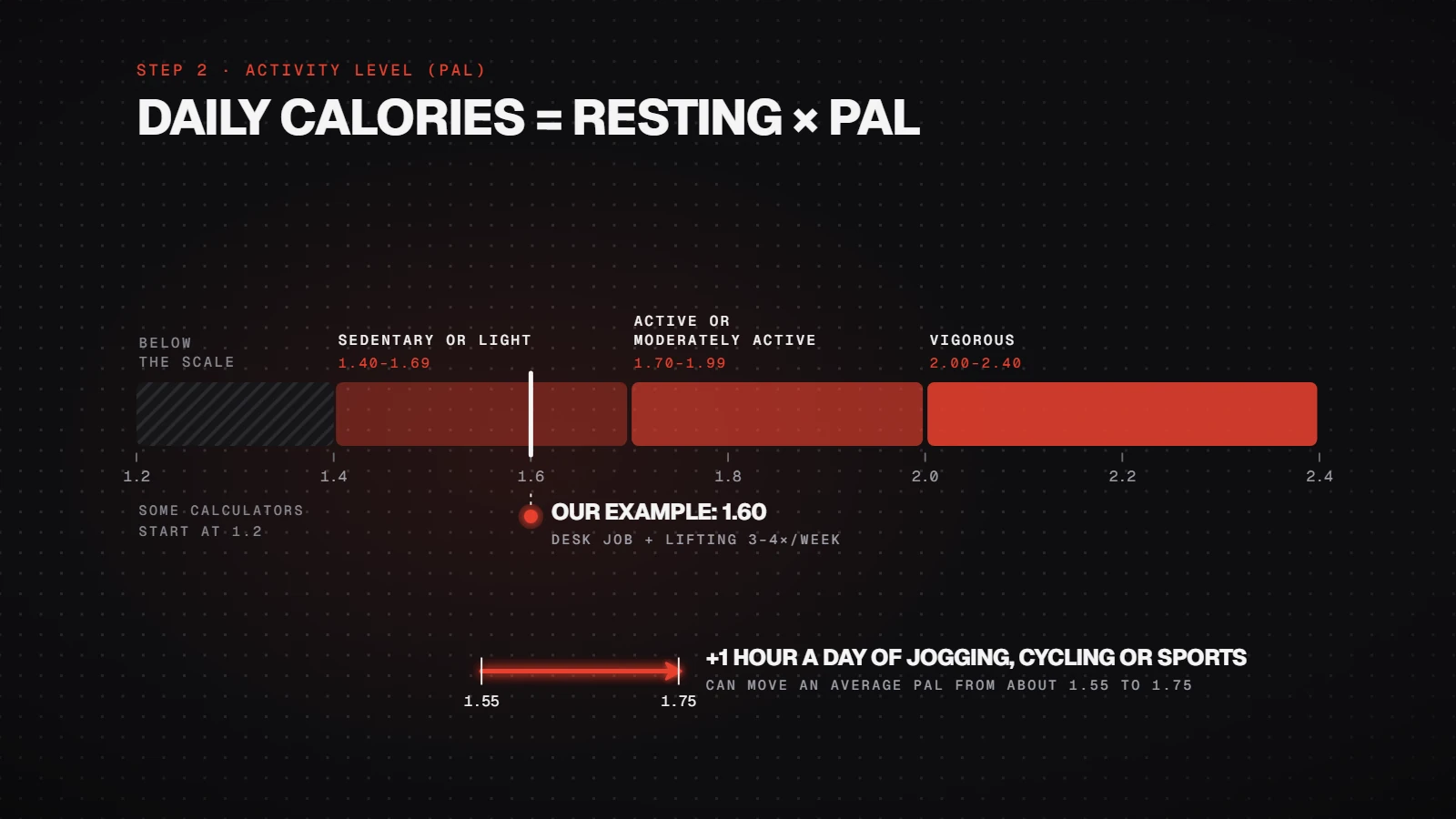
Physical activity level (PAL) is your total daily calorie needs written as a multiple of your resting rate. If your PAL is 1.6, you burn 1.6 times your resting calories over a full day. So:
Daily calories = resting calories × PAL
The FAO/WHO/UNU expert report on energy requirements groups lifestyles into three bands:
- Sedentary or light activity: 1.40 to 1.69
- Active or moderately active: 1.70 to 1.99
- Vigorous: 2.00 to 2.40
Values above 2.40 are hard to keep up for long. To give you a sense of scale, adding one hour a day of moderate-to-vigorous exercise, such as jogging, cycling or sports, can raise someone's average PAL from about 1.55 to 1.75. A few gym sessions a week move the number less than most people expect.
Pick the band for the week you usually live, not the week you plan to have. If you sit at work and train a few times a week, you probably belong in the light band, toward its upper end. If you're unsure between two values, choose the lower one. Your weight trend will tell you within a few weeks whether it was too low (see the tracking section below).
Why some calculators start lower
Many online calculators use multipliers from 1.2 to 1.9, so their lowest setting falls below this scale. In the FAO classification, a figure that low (a mean PAL of about 1.2) was only ever suggested for the short-term survival of totally inactive, dependent people in crisis conditions. It was never meant to describe someone with an office job. Using it can make an ordinary sedentary person's estimate come out lower than it should be.
Keep one limit in mind too. These bands were designed to estimate the needs of population groups, not one specific person. That's one more reason to treat your result as a starting point.
Example: her daily calories
She has a desk job plus regular lifting, which puts her in the upper part of the light band. We'll use a PAL of 1.60.
- 1,400 × 1.60 = 2,240 kcal per day
That's her estimated maintenance level: the calories that would keep her weight roughly steady.
Step 3: Adjust calories for your goal
Losing fat
To lose fat, you eat below your maintenance estimate. A deficit of 300 to 500 kcal a day is a reasonable range for most people. NIH clinical guidelines link that range to roughly ½ to 1 lb a week. Larger deficits of 500 to 1,000 kcal a day are linked to roughly 1 to 2 lb a week. These are typical rates from the guidelines, not a forecast of what you'll see on your own scale.
There are good reasons not to cut harder:
- It tends to last. People who lose weight at a gradual, steady pace of about 1 to 2 lb a week are more likely to keep it off.
- It protects training. For people who train, keeping weekly loss under about 1% of body weight may better protect lean mass and performance. At 150 lb, that ceiling is about 1.5 lb a week.
- It leaves room for the macros. A smaller deficit leaves enough calories to cover protein and a reasonable amount of fat and carbs.
Gaining muscle
To gain, eat a modest amount above maintenance and let the scale climb slowly. A bigger surplus mostly speeds up fat gain, so start small. Your weight trend over the next few weeks will tell you whether to add more.
Maintaining
Eat at your estimate and watch what your weight does. If it holds steady, the estimate was right for you.
Example: her calorie target
She wants to lose fat, so we subtract 400 kcal, near the middle of the moderate range:
- 2,240 − 400 = 1,840 kcal per day
Her macros will be built from that number.
Step 4: Set protein first, then fat, then carbs
Protein: choose a target in g/kg
Protein goes first because it's the macro tied to keeping and building muscle. It's set by body weight rather than as a share of calories. The right range depends on whether you train and whether you're cutting:
| Who | Protein per day | Source |
|---|---|---|
| Adult RDA | 0.8 g/kg | National Academies |
| General adult goal | 1.2–1.6 g/kg | Dietary Guidelines 2025-2030 |
| Athletes, general | 1.2–2.0 g/kg | Joint statement, 2016 |
| Most people who exercise | 1.4–2.0 g/kg | ISSN, 2017 |
| Lifters in a calorie deficit | 2.3–3.1 g/kg | ISSN, 2017 |
The RDA (Recommended Dietary Allowance) is set to cover the basic needs of nearly everyone. It's a floor, not a target for someone who lifts. The Dietary Guidelines for Americans 2025-2030 set a higher everyday goal for adults. The sports-nutrition ranges go higher again for people who train.
Find the row that fits you, then pick a number inside it that you can eat consistently. If you lift and are cutting, the last row needs a word of explanation. That 2.3 to 3.1 g/kg range describes what may be needed to maximize lean-mass retention, the top end of protection rather than a minimum. On a moderate deficit like the 300 to 500 kcal range above, the 1.4 to 2.0 g/kg row is a reasonable place to land, ideally toward its upper end. The higher row is there if you want to push for every bit of muscle retention and can comfortably eat that much.
It also helps to spread protein across the day. The ISSN position stand on protein and exercise suggests about 0.25 g/kg, or 20 to 40 g, every 3 to 4 hours.
Fat: 20 to 35% of calories
Set fat as a share of calories, somewhere between 20 and 35%. The joint sports-nutrition statement from the Academy of Nutrition and Dietetics, Dietitians of Canada and the American College of Sports Medicine discourages staying below 20% over the long term. Fat carries fat-soluble vitamins and essential fatty acids, so cutting it very low for months isn't a good trade.
To convert to grams, multiply calories by your percentage, then divide by 9.
Carbs: whatever is left
Carbs fill the remaining calories. Subtract protein and fat calories from your target, then divide by 4. Two reference points help you judge the result:
- The adult carb RDA is 130 g a day.
- For people who train regularly, the joint statement gives daily targets by training load: about 3 to 5 g/kg for light training and 5 to 7 g/kg for moderate training of about an hour a day.
Check against the official ranges
The Acceptable Macronutrient Distribution Ranges (AMDR) are the official adult ranges, written as a share of daily calories:
- Carbs: 45 to 65%
- Fat: 20 to 35%
- Protein: 10 to 35%
Divide each macro's calories by your total. If something falls outside its range, adjust your fat percentage or protein choice and run the numbers again.
Example: her macros
- Protein: 1.8 g/kg × 68 = 122 g → 122 × 4 = 488 kcal
- Fat: 28% of 1,840 = 515 kcal → ÷ 9 = 57 g (57 × 9 = 513 kcal)
- Carbs: 1,840 − 488 − 513 = 839 kcal → ÷ 4 = about 210 g
She chose 1.8 g/kg because her 400 kcal deficit is moderate, which puts her in the 1.4 to 2.0 g/kg row, and she went toward the upper end of it since she's lifting through a cut. Moving into the maximum-retention row would mean at least 2.3 × 68 = about 156 g a day, which is more than she can realistically eat every day on 1,840 kcal.
Now the check. Protein is about 27% of calories, fat about 28% and carbs about 46%. All three fall inside the adult ranges. Her carbs are well above the 130 g RDA and work out to about 3.1 g/kg, which fits the light-training range.
All her numbers in one place
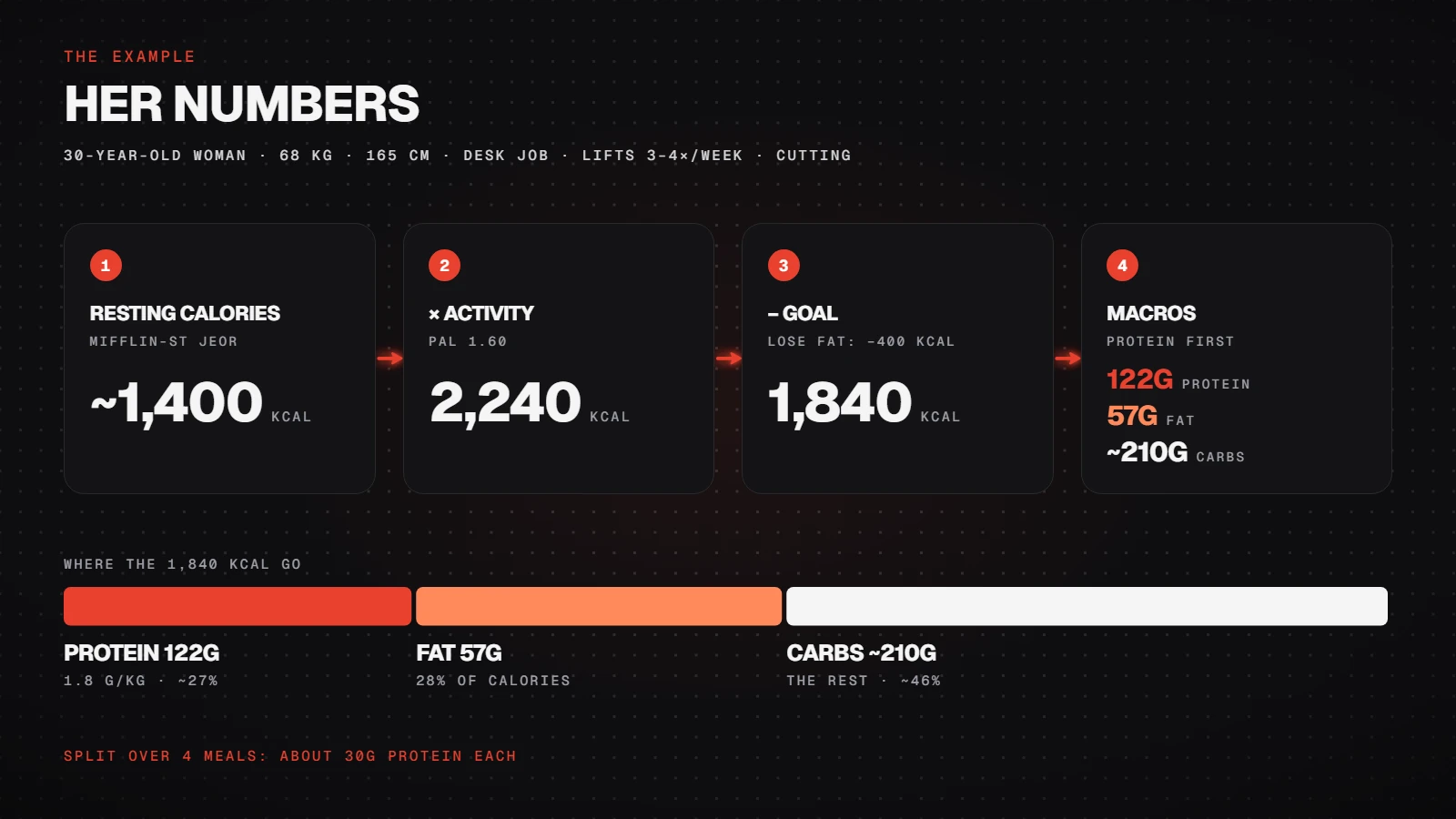
Here are her numbers in one place, to use as a template with your own stats:
30-year-old woman, 150 lb (68 kg), 5 ft 5 in (165 cm), desk job, lifts 3 to 4×/week, cutting
- Resting calories (Mifflin-St Jeor): about 1,400 kcal
- Activity (PAL 1.60): 2,240 kcal
- Goal (−400 kcal): 1,840 kcal
- Protein (1.8 g/kg): 122 g
- Fat (28%): 57 g
- Carbs (remainder): about 210 g
Split over four meals, that's roughly 30 g of protein each time, which fits the 20 to 40 g per-meal guidance.
If she maintains instead
Suppose she decides to hold her weight. Her target goes back to 2,240 kcal, which adds 400 kcal. Protein stays at 122 g and fat stays at 57 g. The extra 400 kcal goes to carbs: 400 ÷ 4 = 100 g, so carbs rise to about 310 g.
That's the advantage of building macros in this order. When the calorie target moves, protein holds steady and carbs absorb most of the change.
Why protein comes before a 40/30/30 split
A percentage split like 40/30/30 hands out your calories by share. Converting it to grams is simple. On 2,000 kcal:
- 40% carbs: 800 kcal ÷ 4 = 200 g
- 30% protein: 600 kcal ÷ 4 = 150 g
- 30% fat: 600 kcal ÷ 9 = about 67 g
The problem is that a split ties protein to calories. When calories drop for a cut, protein drops with them, right when you most want to keep it high.
Here's how that plays out. Say our example woman used a 50/20/30 split at her 1,840 kcal target. Protein would be 20% of 1,840 = 368 kcal, or 92 g. That's about 1.35 g/kg, below even the bottom of the 1.4 to 2.0 range for people who exercise and well short of the 1.8 g/kg she chose for her cut. Setting protein in g/kg first avoids that, because the protein number stays put whatever your calorie target does.
Splits aren't wrong. They're a quick way to describe a diet, and a split that comes out of your g/kg math works fine. The protein target should come first, though, and the percentages should follow from it.
Track, watch the trend and adjust
Every number above is an estimate. The equation, the PAL bands and the deficit guidance all describe typical people, and your body may run a little hotter or cooler. The way to find out is to eat at your targets and see what happens.
- Track with food labels or an app, weighing foods with a kitchen scale when you can. Measuring by eye drifts, especially with oils and nut butters.
- Weigh yourself regularly and look at the trend over a couple of weeks. Single weigh-ins move with water, salt and meal timing, so one morning tells you very little.
- Adjust in small steps. If the trend doesn't match your goal after about two weeks, change calories by a modest amount, usually by moving carbs or fat. Then give it another couple of weeks.
- Recalculate when your weight has changed noticeably. Your resting calories and your protein target both depend on body weight.
If you're pregnant, have a medical condition, or have a history of disordered eating, work with a registered dietitian instead of running these numbers on your own.
FAQ
Should I use Mifflin-St Jeor or Harris-Benedict?
Mifflin-St Jeor. It was built from a more recent group of adults that included both normal-weight and obese people. In the same study, the 1919 Harris-Benedict equations overestimated measured resting calories by about 5%.
Why is my number different from an online macro calculator?
Calculators make different choices. Many use activity multipliers starting at 1.2, which is lower than the published PAL bands. They also differ in how big a deficit they apply and whether they set protein by body weight or as a percentage. Small differences at each step add up. Whichever number you start with, your weight trend is what tells you whether it's right.
Should I calculate protein from my current weight or my goal weight?
The g/kg targets are written per kilogram of body weight, so start with your current weight. As your weight changes, recalculate, and your protein target will move with it.
Do I need to hit my macros exactly every day?
No. Aim to land close most days, with protein as the number to be most consistent with. A day that runs 10 g over on carbs or under on fat won't change your weekly trend. What matters is how your average intake lines up with your targets over a couple of weeks.
How often should I recalculate my macros?
Recalculate when your body weight has shifted noticeably, when your training changes a lot (for example, adding daily sessions or stopping for a while), or when your goal switches between cutting, maintaining and gaining. Between those points, small calorie adjustments based on your weight trend are usually enough.