Forearm Plank: How to Do It With Proper Form
Hold a forearm plank with elbows under shoulders and a straight line head to heels, and stop when hips sag. Plus hold times, fixes, easier and harder versions.
- Difficulty
- Beginner
- Equipment
- None
- Sets
- 3 × 20–30 sec
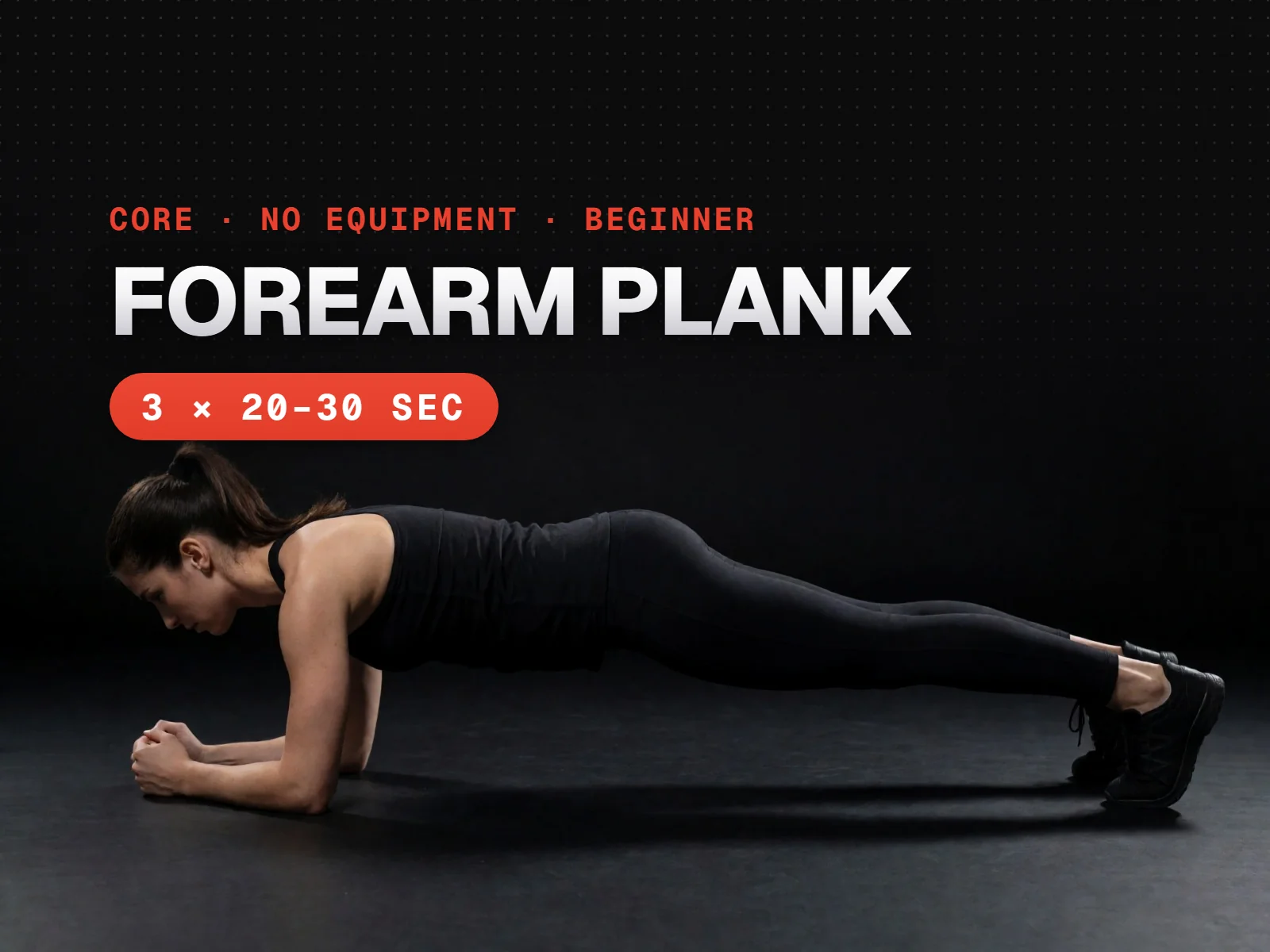
A good forearm plank is a still, steady hold. You're face down on your forearms and toes, with your elbows under your shoulders and your body in one straight line from your head to your heels. Your abs are braced and you keep breathing. Hold it only as long as that line stays straight. For most beginners that's 10 to 15 seconds at a time, done 2 to 3 times a week.
You don't need equipment, just a patch of floor and maybe a towel under your elbows. Here's how to set it up, what it trains, how to tell when your set is over, and where to go once a basic plank gets easy.
How to Do a Forearm Plank With Good Form
Picture a board resting on 2 points: your forearms at one end and your toes at the other. Nothing in the middle sags, and nothing pokes up. That's the shape you're building.
- Lie face down with your forearms on the floor. Put your elbows directly under your shoulders, palms down, hands facing forward.
- Set your feet about hip-width apart and tuck your toes, pulling your ankles toward your shins.
- Brace your core by tightening your abs and drawing your belly button toward your spine. Squeeze your glutes and thighs too.
- Lift your body off the floor so you form a straight line from head to heels. Keep your torso and legs stiff.
- Keep your shoulders stacked right over your elbows and pressed down, away from your ears.
- Keep your head in line with your spine and look at the floor slightly in front of your hands.
- Breathe steadily the whole time.
- To finish, lower yourself gently to the floor with your torso still stiff and your knees straight.
Before your first real set, prop your phone against the couch and film 1 hold from the side, or set up next to a mirror. Most people find their hips sit higher than they thought. A 15-second clip tells you more than any cue.
What a Forearm Plank Works (and What It Doesn't)
The main work happens in 2 places: the rectus abdominis, the "six-pack" muscle down the front of your stomach, and the transverse abdominis, a deeper layer that wraps around your middle like a belt. The muscles on your sides, the long muscles along your spine, the muscles along your ribs under your armpits, and the small muscles that keep your shoulders steady all help hold the position. Because you squeeze your glutes and thighs during the setup, they're working too.
Here's what that means for you. A plank asks your trunk muscles for a fairly low, steady effort. In a 2007 study of 30 adults, the plank on elbows and toes kept trunk muscle activity below 45% of maximum. That level builds endurance and helps your middle stay steady while you carry groceries, pick up a kid, or hold your torso still under a barbell. It won't build maximum strength the way heavier lifting does.
It also burns very little energy. In a 2015 study of 10 trained men, 3 sets of 30-second planks had the lowest oxygen uptake of 13 workouts tested (7.9 ml/kg/min). A 2024 study of 10 young adults ranked the plank lowest of 7 body-weight exercises for heart rate, effort, and energy cost. Think of the plank as a core-steadiness tool, not cardio.
One thing to know if you lift: in a 2020 study of 7 trained men, the plank produced more activity in the front abs and side abs than front squats or overhead squats did. So if you've been assuming your squats cover your abs, a few planks still have a place.
Because the benefit comes from holding a good position under steady effort, how you hold it matters a lot more than how long.
Mistakes That End the Set
Each of these is easy to spot on video and easy to fix.
Hips sagging
Your lower back arches and your belly drifts toward the floor. Fix it by squeezing your glutes harder and pulling your belly button in.
Hips piked up
Your body makes a tent shape. Lower your hips until your shoulders, hips, and heels line up.
Shoulders shrugging
Your neck disappears into your shoulders. Push the floor away through your forearms and pull your shoulders down.
Elbows in the wrong spot
Elbows too far in front of or behind your shoulders change the load and strain your shoulders. Stack them directly underneath.
Head out of line
Your head either drops toward the floor or cranes up to look ahead. Keep your gaze just in front of your hands so your neck stays long.
Holding your breath
Count your breaths out loud, or just keep breathing slowly through your nose. If you can't breathe, the hold is too hard right now.
Adding time too fast
Jumping from 20 seconds to 60 because an app said so usually just means 40 seconds of bad position. Add time only when the last few seconds still look good.
The most important point: once your back sags or your hips rise, the useful part of the set is over. Say you're aiming for 60 seconds and your hips start dropping at 40. Stop there, write down 40, and try again next session. Grinding out the last 20 seconds just trains the sag.
There's another reason to stop early. In a 2026 study of 30 adults who held planks until they couldn't any longer, untrained people leaned more on their lower-back muscles than trained people did. As your abs tire, your back tends to take over, which is the opposite of what you want.
If you feel pain in your lower back during a plank, stop and see a doctor.
How Long to Hold It and How Often
Coaching advice on this varies, but it fits into a simple plan:
- New to it: hold 10 to 15 seconds and repeat for several good holds.
- Building up: work toward holds of 20 to 30 seconds, then 60 seconds or longer as your core gets stronger.
- Time to switch: once you can hold good form for about 30 to 45 seconds, move to a harder version instead of adding more time.
- What counts: any clean hold of 5 seconds or more is a real plank.
- How often: 2 to 3 times a week. You don't need to plank every day.
A 30-second plank with good form is worth more than a 60-second one with sagging hips. Several 10- to 30-second holds usually do more for you than one long, shaky one. Leave the multi-minute plank records to people who enjoy that sort of thing.
Example: a beginner's week
Here's one way a week could look. It's a sample, not a prescription.
| Day | Plan |
|---|---|
| Monday | 3 holds of 20 seconds, rest 30 to 60 seconds between |
| Wednesday | 3 holds of 20 seconds, rest 30 to 60 seconds between |
| Friday | 3 holds of 20 seconds, rest 30 to 60 seconds between |
If the third hold on Friday still looks clean on video, try 25 seconds next week. If you're already at 30 to 45 seconds of tidy holds, skip ahead to a harder version below.
Easier Versions if a Full Plank Is Too Much
If you can't hold a straight line for 10 seconds on the floor, use one of these. Neither one is cheating.
Incline plank
Put your forearms on a bench or a sturdy box, or against a wall, and walk your feet back until your body is straight. The higher the surface, the easier it gets. A wall is the gentlest place to start, and a low step is close to the real thing.
Knee plank
Set up as usual, but rest your knees on the floor instead of your toes. Your body should make a straight line from head to knees, and the same rules apply: no sagging and no piking.
My pick: start with whichever version lets you hold a straight line for 10 to 15 seconds. For many people that's a knee plank, and some do better with an incline. Build that to about 30 seconds, then try the full plank.
Harder Versions Once You're Ready
When you reach 30 to 45 clean seconds, move up this ladder one step at a time, roughly from easiest to hardest.
Side plank
Lie on your side, prop yourself on 1 forearm with your elbow under your shoulder, and lift your hips into a straight line. Start with your knees bent and stacked, then straighten your legs when that feels steady.
Plank with shoulder taps
Do this one from a straight-arm plank on your hands. Tap 1 hand to the opposite shoulder, put it back, and switch. Widen your feet if your hips rock side to side.
Arm and leg lifts
From your plank, lift your opposite arm and leg together and hold for a breath. Once that's steady, lift a single arm, then a single leg. Each lift takes away a point of support, so your middle has to work harder to stay still.
Long-lever plank with a pelvic tilt
This one breaks the elbows-under-shoulders rule on purpose. Place your elbows a little farther forward than usual, tuck your tailbone under so your lower back flattens, and squeeze your glutes hard. In a 2014 study of 19 people doing 30-second holds, this version produced more activity in the upper abs, lower abs, and side abs than a standard plank. Moving the elbows forward made the bigger difference. Your standard plank still keeps your elbows stacked. Only this variation moves them.
Drawing your belly in
During a normal plank, pull your belly button in hard and keep it there. In a 2020 study of 20 people, this raised side-ab and lower-back muscle activity and made the plank feel harder. Front-ab activity didn't change.
Feet raised
Put your feet up on a step or the couch while your forearms stay on the floor. A 2024 study of 24 young adults found that raising the feet higher increased front-ab and side-ab activity.
Body saw and walkouts
For a body saw, set up on your forearms with your feet on a towel on a smooth floor, then rock your body forward and back a few inches while keeping it straight. For a walkout, start standing, walk your hands out into a straight-arm plank, then walk back.
Ball or suspension trainer
Put your forearms on a stability ball, or your feet in suspension straps. The wobble makes every second harder, so drop your hold time when you first try it.
Forearm or straight-arm plank?
They're 2 versions of the same exercise. The forearm plank keeps your wrists out of it, which helps if your wrists complain. Choose the one you can hold cleanly, or rotate between them.
FAQ
Should I plank every day?
You don't need to. 2 to 3 sessions a week is enough, and those spare days are better spent on other training.
Why do I feel planks in my lower back?
Usually your hips are sagging. Film a hold, squeeze your glutes, pull your belly in, and shorten the hold. If your lower back still hurts during a plank, stop and see a doctor.
Is it better to hold longer or do more sets?
Do more good holds. Several 10- to 30-second planks beat one long, sloppy one. Once you reach about 30 to 45 seconds, make the plank harder instead of longer.
Can planks give me abs or burn belly fat?
Planks build core endurance and help your middle stay steady, which is useful for everyday life and lifting. They burn very little energy, though, and no exercise picks where your body loses fat. Treat planks as part of your training, not a shortcut to a certain look.
What if I can't hold a plank at all yet?
Start with an incline plank against a wall or bench, or a knee plank. Hold a straight line for 10 to 15 seconds, repeat a few times, and lower the incline or switch to your toes as it gets easier.
Further reading: ACE Exercise Library: Front Plank, ACE Exercise Library: Single Arm, Single Leg Plank, Strand et al. (2014) Norms for an Isometric Muscle Endurance Test, Journal of Human Kinetics.