Goblet Squat Form: How to Do It and Muscles Worked
Goblet squat form: keep the weight tight to your chest, sit your hips down between your knees and stop before your lower back rounds. Plus grips and fixes.
- Difficulty
- Beginner
- Equipment
- Dumbbell
- Sets
- 3 × 10–15 reps
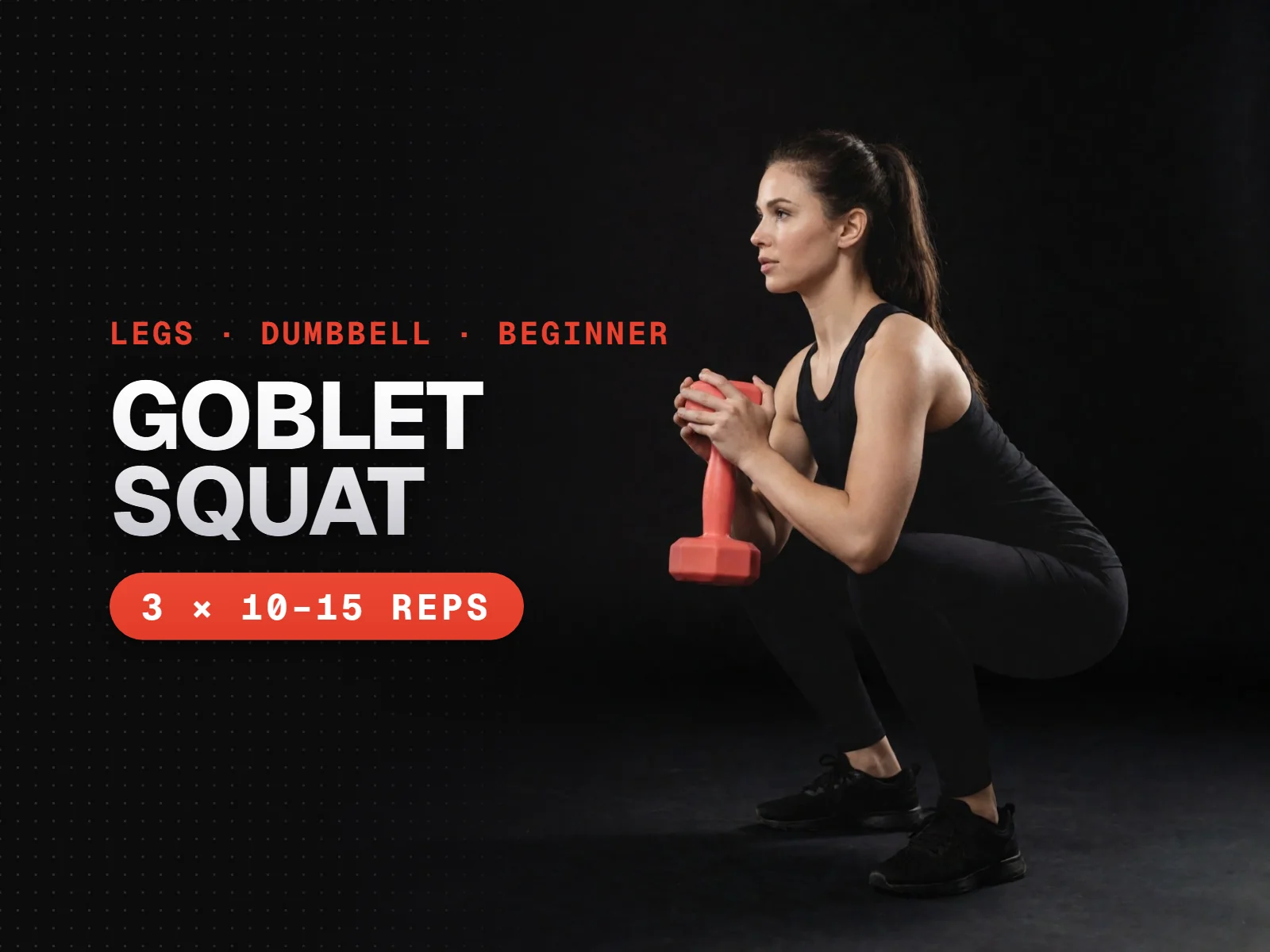
Good goblet squat form comes down to three things: keep the weight tight to your chest, sit your hips back and down between your knees, and go only as deep as your lower back can stay flat. Most of the problems people run into, like tipping forward, caving knees, or the weight pulling them over, come from losing one of those three. Below is the full rep, how to hold each type of weight, how to set your own stance and depth, and a simple plan for adding weight.
What a Good Goblet Squat Looks Like
Picture someone doing it well from the side. The weight sits against their chest, under the chin, with the elbows pointing down and tucked in. Their chest stays tall the whole time. As they lower, their hips go down and slightly back between their knees, not far back like they're reaching for a chair behind them. At the bottom, their torso is fairly upright and their lower back is still flat. Then they push the floor away and stand up in one smooth line.
From the front, their knees follow the line of their toes all the way down and back up. They don't buckle inward. Their heels stay planted.
If your squat looks roughly like that, you're in good shape. The steps below fill in the details.
Goblet Squat Form, Step by Step
- Stand with your feet between hip-width and shoulder-width apart, toes pointing straight ahead or turned slightly out.
- Hold the weight at chest height with both hands. Tuck your elbows close to your ribs and set your shoulder blades, as if you're gently pulling them down and back.
- Take a breath in and tighten your core, like you're bracing for a light poke in the stomach. Do this before every rep.
- Keep your chest tall, your back straight and the weight close to your chest.
- Sit your hips back and down between your knees. Let your knees track over your toes as you lower.
- Go as deep as you can without your lower back rounding.
- Push your feet into the floor to stand back up, and squeeze your glutes at the top.
For tempo, I'd take about 2 to 3 seconds on the way down, pause for a beat at the bottom if you can hold your position, then stand up in about 1 second. Slowing the lowering part gives you time to notice what your knees and back are doing, which is the whole point when you're learning.
Dumbbell or Kettlebell: How to Hold Each One
The goblet squat is the same movement whatever you hold. Only the shape of the weight changes, and that changes your grip.
Dumbbell: Stand it on end and hold it upright against your chest. Cup the top end with both palms, like you're holding a heavy goblet, with your fingers wrapped around the plate. The bottom end hangs down toward your stomach.
Kettlebell: You've got two options. Hold it by the horns, which are the two sides of the handle, with the bell hanging upside-down-ish in front of your chest. Or flip it so the handle points down and hold the ball itself in your palms. Holding the horns is the more common way and feels steadier for most people. Holding the ball keeps the weight a little closer to your body.
Medicine ball: Hug it against your chest with both hands. It works fine, especially at lighter weights.
| Weight | How you hold it | Comfort at the chest | Going up in small steps |
|---|---|---|---|
| Dumbbell | Upright, palms cupping the top end | Sits flat and close, easy to keep tucked | Usually easy, since most dumbbell sets go up in small jumps |
| Kettlebell | By the horns, or by the ball | Horns grip feels secure; the bell can press into your forearms | Usually bigger jumps between sizes |
| Medicine ball | Hugged against the chest | Soft and comfortable | Limited, and heavy ones get bulky to hold |
My verdict: use whatever you already own. If you're buying something just for this, a dumbbell is the easier choice because you'll be able to add weight in smaller steps.
Picking Your Stance, Depth and Foot Pressure
This is where coaches give slightly different numbers, and that's fine. Bodies are built differently, so you'll get more out of finding your own setup than copying someone else's exactly.
Foot width and toe angle
Good advice ranges from hip-width to about shoulder-width, with toes straight ahead or turned out a little. Here's how to find yours.
Start at hip-width with your toes forward and do 3 or 4 slow bodyweight squats. Then try shoulder-width with your toes turned out slightly and do 3 or 4 more. Pick the one where your hips drop down between your knees most easily and your knees can follow your toes without strain. Lots of people find that turning the toes out a touch frees up their hips at the bottom. Whatever you choose, use the same setup every set so you can compare one session to the next.
How deep to go
You'll hear "thighs parallel to the floor," "hips below the knees" and "as deep as you can." The guide I'd trust over any of those is your own lower back.
Go down slowly and stop at the point just before your lower back starts to round or your tailbone starts to tuck under. That's your depth for now. For one person it's well below parallel. For someone with stiff hips or ankles, it might be a few inches higher. Both are fine. Holding the weight in front helps here too, since many people find they can squat deeper and more upright in a goblet squat than with no weight at all.
A quick way to check: film one set from the side at hip height. Watch the curve of your lower back at the bottom. If it stays the same shape as when you started, you're good.
Where your weight sits in your feet
Push your whole foot into the floor, with your weight shifted a little toward your heels. Your toes can stay relaxed, but your heels should never lift. If they come up, you're either going deeper than your ankles allow right now or tipping forward, and the mistakes section below covers both.
Yes, Your Knees Can Go Past Your Toes
"Keep your knees behind your toes" is one of the most repeated squat rules around, and it doesn't hold up.
In a 2003 study, 7 weight-trained men did barbell squats to parallel. In some sets, they squatted normally. In others, their knees were physically blocked from moving past their toes. Blocking the knees did lower the load on the knee a little, from 150 to 117 units of torque. But the load on the hips shot up from 28 to 303. That's more than ten times higher. The men also leaned their torsos farther forward to stay balanced.
In plain terms: when you hold your knees back, the work doesn't vanish. It moves to your hips and lower back, and you fold forward to make up for it. The researchers concluded that the knees may need to travel slightly past the toes for the load to be spread sensibly across your joints.
A 2013 review of more than 164 articles looked at deep squats more broadly. It found that when people learned the technique with expert guidance and added weight gradually, deep squats didn't raise injury risk to the passive tissues of the knee, like ligaments and cartilage. It also found that pressure behind the kneecap peaks at around a 90-degree knee bend and drops as you go deeper. So going lower isn't automatically harder on your knees.
What does matter is the direction your knees travel. Let them go forward over your toes, and keep them pointing the same way your feet do.
Muscles the Goblet Squat Works
Your quads, the muscles on the front of your thighs, do much of the work. They straighten your knee as you stand up. Your glutes are the other main mover, driving your hips forward to finish the rep.
Helping out are your hamstrings, your adductors (the inner thigh muscles), and the smaller muscles around your hips that keep your knees from wobbling. Your core holds your torso upright so you don't fold over, and your lats and upper back hold the weight in place against your chest.
One study of 16 men and 16 women, each squatting with a load equal to 30% of their body weight, found the goblet squat produced more quad activity and more upward force than a landmine squat. The women in that study showed more quad activity than the men.
What you should feel: mostly the front of your thighs and your glutes, with your upper back and core working to keep you upright. If your lower back is the thing that's tired after a set, something's off with your form.
How Heavy to Go, and How Many Sets and Reps
A good starting plan is 3 sets of 10 to 15 reps at a controlled pace. If you'd rather lift a bit heavier, pick a weight you can do for 8 to 12 reps. Rest 60 to 90 seconds between sets.
Is the weight right?
The test is simple. On every rep, can you stay upright, keep the weight tight to your chest and reach your full depth? If yes, the weight is fine. If you start tipping forward or cutting reps short, or your back starts to round by rep 8, it's too heavy for now.
My own advice is to end each set with about 2 good reps still in the tank. You should feel like you could do a couple more clean ones if someone made you. Grinding out ugly reps at the end doesn't teach you anything useful.
When to go heavier
Once you can hit the top of your rep range on every set with clean form, move up.
Example: going from 20 lb to 25 lb
Say you start with a 20 lb dumbbell and do 3 sets of 10 in week 1. It feels solid. By week 2, you're getting 12 or 13 reps per set. By week 3, you're doing all 3 sets of 15 with your chest tall and plenty left over. That's your cue. In week 4, you pick up the 25 lb dumbbell and drop back to around 10 reps per set, then build back up toward 15 the same way.
Why your arms will eventually give out first
The goblet squat limits itself: you can only squat what you can hold at your chest. Your legs are much stronger than your arms and upper back, so at some point you'll finish a set with your legs still feeling fine but your arms and upper back cooked from holding the weight. When that happens consistently, the goblet squat has done its job as your main squat, and it's time to look at the options further down.
Common Goblet Squat Mistakes and How to Fix Them
The fastest way to spot these is to prop your phone up and film one set, once from the side and once from the front. You'll see things you can't feel.
Knees caving in
Your knees drift toward each other, usually on the way up. Fix: Think about spreading the floor apart with your feet, and push your knees out so they stay in line with your toes.
Leaning too far forward
Your chest drops toward your thighs, which puts extra strain on your lower back. Fix: Pull the weight in tighter, keep your elbows pointing down, and think "chest up" as you lower. If you still tip, the weight is probably too heavy.
Squatting too shallow
You stop a few inches down and call it a rep. Fix: Lower the weight or use none at all, slow the descent to 3 seconds, and find out where your real depth is.
Lower back rounding at the bottom
Your tailbone tucks under and your lower back curves. Fix: Stop a little higher, right before that happens. Your depth can improve over time, but don't force it.
Chest dropping or the weight drifting away
The weight slides away from your body and pulls you forward. Fix: Keep the weight touching your chest the whole rep. Imagine it's glued there.
Feet turning out from where you set them
Your feet slowly rotate or shuffle during the set. Fix: Set your feet, then press them firmly into the floor before every rep. Some people like lining their toes up on a floor tile or mat edge to check.
Losing your brace between reps
You breathe out and go loose at the top, then drop into the next rep soft. Fix: Take a fresh breath and tighten your core at the top of every single rep before you lower.
Jerky, rushed reps
You drop fast and bounce out of the bottom. Fix: Count 2 to 3 seconds on the way down, and pause briefly at the bottom before standing.
Easier and Harder Versions
If it's too hard
Drop the weight and do a bodyweight box squat. Stand in front of a sturdy box, bench or chair, sit down to it under control, then stand back up. The box tells you where the bottom is, so you don't have to guess.
Once that feels solid, a goblet squat to a box is a nice step up. Same idea, but now you're holding a light weight. A paused goblet squat, where you hold the bottom position for 2 to 3 seconds, is great for learning control and getting comfortable at depth.
If it's too easy
First, go heavier. That's the simplest move, and it'll keep working for a while.
When you're running out of weight you can comfortably hold, try a related move:
- Dumbbell front squat: Hold a dumbbell on each shoulder. You can load more total weight than with one held at your chest.
- Kettlebell front squat: Same idea with two kettlebells resting in front of your shoulders.
- Bulgarian split squat: One foot back on a bench, squatting on the front leg. Working one leg at a time makes even a light weight feel heavy.
Goblet Squat vs Barbell Squat
The goblet squat is easier to learn. Having the weight in front of you acts as a counterbalance, so it's easier to stay upright and sit deep. It's a great first loaded squat, and it teaches the pattern you'll use under a barbell later.
The barbell squat lets you load far more weight. Since the bar sits on your back, your arms aren't the limiting factor anymore, and you can keep challenging your legs for a long time.
My verdict: start with the goblet squat. Stay with it while it's still challenging your legs. When your arms and upper back are giving out before your legs on most sets, and your goblet squat form looks clean on video, that's a good time to start learning the barbell squat.
FAQ
Is the goblet squat good for beginners?
Yes. It's one of the easiest loaded squats to learn because the weight in front helps you stay upright and find your depth. If even a light weight feels shaky, start with a bodyweight box squat for a few sessions.
How heavy should a goblet squat be?
Heavy enough that the last couple of reps take effort, but light enough that every rep stays upright and reaches your full depth. For many beginners, that's a dumbbell they can lift for 10 to 15 reps.
Can I do goblet squats every day?
A few light bodyweight reps to practice the movement are fine most days. For your real weighted sets, 2 to 3 sessions a week with a rest day between them gives your legs time to recover.
Why do I fall forward in a goblet squat?
Usually the weight has drifted away from your chest, your heels are lifting, or the weight is too heavy for now. Pull it in tight, keep your whole foot on the floor, and drop to a lighter weight if you still tip.
Should my heels come up?
No, keep them down the whole time. If they lift, try a slightly wider stance with your toes turned out a little, and stop a bit higher until your ankles loosen up.
Further reading: ACE Exercise Library – Goblet Squat, ACE – How to Get Started With Kettlebells, NASM Exercise Library – Goblet Squat.