How to Do a Push-Up With Proper Form
How to do a push-up with good form: hand and elbow position, how low to go, common mistakes to fix, and easier and harder versions to build up.
- Difficulty
- Beginner
- Equipment
- None
- Sets
- 3 × 8–15 reps
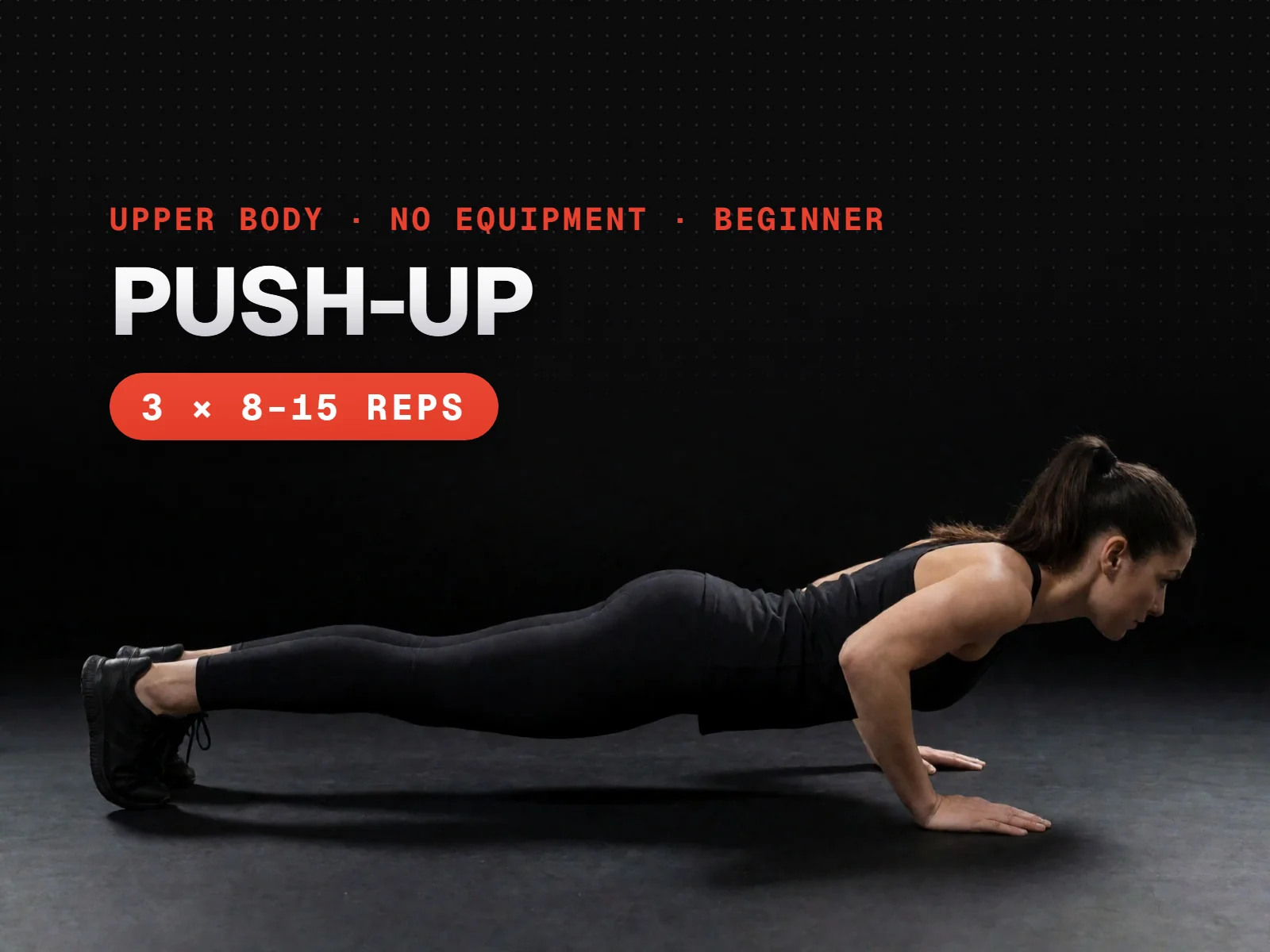
Put your hands on the floor about shoulder-width apart, walk your feet back so your shoulders sit right over your hands, and make one straight line from your head to your heels. Lower yourself under control until your chest nearly touches the floor, then push the floor away until your arms are straight again. That's one rep.
If that sounds simple but feels hard, or you can't do one yet, that's normal.
How to Do a Push-Up, Step by Step
Before you start, picture a plank that happens to move. Your arms do the bending. Everything else stays stiff.
- Place your hands on the floor about shoulder-width apart, fingers pointing forward or turned slightly in.
- Step your feet back, together or hip-width apart, with your toes tucked under so your ankles pull toward your shins.
- Shift your weight forward until your shoulders are directly over your hands.
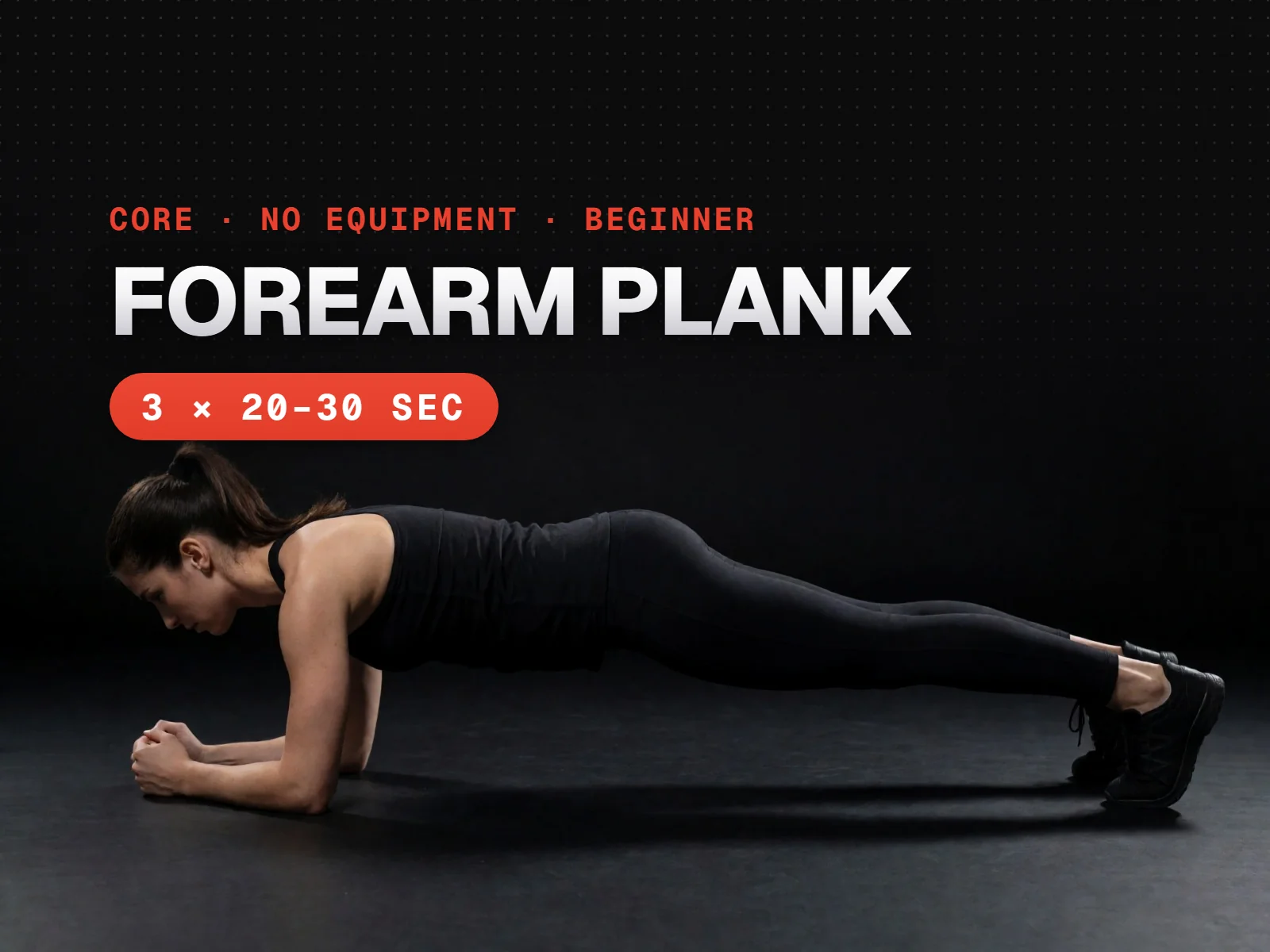
- Make a straight line from your head to your heels, with no bend at your hips or knees.
- Brace your stomach, squeeze your glutes and thighs, and keep your head in line with your spine. Look at the floor a little ahead of your hands.
- Lower your body slowly, keeping your torso rigid, until your chest is nearly on the floor.
- Push the floor away to straighten your arms, keeping your hips and lower back still the whole way up.
Breathe in as you lower and out as you press up. If you find yourself holding your breath, slow the rep down until you can breathe through it.
One cue most people never hear: press through the heel of your hand and the outer edge of your palm. Your hand should feel planted, like you're trying to screw it into the floor, not like you're resting your weight on your fingertips. That helps you push harder.
Where Your Hands Go
Shoulder-width is the default because it lines your hands up under your shoulders, which keeps your wrists, elbows and shoulders stacked. If you look down at the bottom of a rep, your hands should be roughly under your chest, not out past your head.
A lot of people believe wide hands make it a "chest" push-up. They don't. In a 2005 study of 40 adults, a narrow hand position produced more chest and triceps activity than a wide one. Wide push-ups are fine if you want variety, but you're not trading triceps for chest by moving your hands out.
Hand width also changes what your elbows do, and that's where people get mixed messages.
Elbow Angle: Where Coaches Disagree
There isn't one correct elbow angle, and good coaches teach it differently:
- About 45 degrees. A common coaching standard keeps the elbows at roughly 45 degrees from your body, because flaring them wide puts more stress on the shoulders.
- Flared out. Other standard instructions let the elbows drift outward on the way down.
- Tucked in. Turning your hands to face forward and keeping your elbows close to your sides shifts work from your chest toward your triceps and may reduce stress on the shoulder joint.
My take: start at about 45 degrees. A simple way to picture it is to imagine someone filming you from the ceiling. Your body and arms should look like an arrow pointing forward, not a T. If your elbows shoot straight out to the sides so you look like a T, bring them in.
If your shoulders complain, tuck your elbows a bit more, shorten how low you go, or drop back to an incline or knee push-up. Don't push through shoulder pain to hit a number.
How Low to Go and How Far to Press
Aim to bring your chest nearly to the floor. Some coaching has your chest or chin touching. If your shoulders or wrists won't let you get that low yet, stopping when your elbows reach about 90 degrees is an accepted alternative. Pick one depth and hit it every rep so you can tell whether you're improving.
At the top, you have two reasonable options:
- Press until your arms are fully straight. This is the standard many coaches teach.
- Stop just short of locking your elbows. Others prefer this because your muscles stay working instead of resting on your joints.
Either is fine. What isn't fine is stopping halfway up and dropping straight back down.
Here's why people cheat the bottom. In a 2011 study of 28 strength-trained men, the hands supported less body weight at the top of a push-up than at the bottom, in both standard and knee push-ups. So the lowest few inches are the heaviest part of the rep. That's also where most of the useful work happens, which is why chopping the range short makes the set easier and less effective.
What Muscles Push-Ups Work
The two main movers are:
- Chest (pectoralis major): brings your upper arm across your body as you press.
- Triceps: straightens your elbow.
Helping out are the front of your shoulders, a smaller chest muscle called the pectoralis minor, and the serratus anterior, which runs along your ribs under your armpit. Your core works the entire time to keep you from folding in the middle, so a hard set of push-ups also feels like a hard plank.
Push-ups get treated as a warm-up move, but they're real strength training. A 2019 study of 20 resistance-trained men compared push-ups (plain and with a 10, 20 or 30 kg weight vest) to bench press at four loads. Across the 8 upper-body muscles measured, there were no differences in muscle activation or movement. Two training studies line up with that. In a 2018 study, 23 moderately trained men who did progressive push-up training 3 days a week for 4 weeks raised their bench press 1-rep max, as the bench press group did. In a 2015 study of 30 trained university students, 5 weeks of elastic-band push-ups gave strength gains similar to bench press.
Those are results in those specific groups, and your own progress will depend on your training and how consistent you are. But it does mean push-ups deserve a proper spot in your week, not just in the warm-up.
Common Push-Up Mistakes and How to Fix Them
Hips sagging toward the floor
This is the big one. Your lower back dips and your belly hangs. Squeeze your glutes hard and brace your stomach like someone's about to poke you in it. If you still sag, the version is too hard for now, so switch to a higher surface, like the kitchen counter.
Hips piked up in the air
Your body makes an upside-down V and your shoulders do extra work. Lower your hips until you're in a straight line, and think "long body" from head to heels.
Head pushed forward or dropped
Craning your neck to look ahead and letting your head hang both break the line. Keep your eyes on the floor slightly in front of your hands, with your neck long.
Elbows flaring too wide
Your arms make that T shape. Bring them back toward 45 degrees.
Only going partway down
Half reps feel productive because they're easier. Pick your depth, chest nearly to the floor or elbows at 90 degrees, and hit it every time.
Leaning too far forward
If your shoulders drift way past your hands, more work shifts onto your shoulders and triceps. Start each set with your shoulders stacked over your hands and keep them there.
Shrugging your shoulders toward your ears
Your neck disappears. Think about keeping space between your ears and shoulders, and pushing the floor away rather than hunching into it.
Bouncing, jerky reps
Dropping fast and bouncing off the bottom uses momentum instead of muscle. Take about 2 seconds to lower and press up smoothly.
Check yourself on video
Prop your phone on the floor a few feet away, side-on, and film one set. You'll spot a sagging back or short reps in seconds, which is far easier than trying to feel it mid-set.
Can't Do One Yet? Start Here
Nobody starts at the top. The easiest place to begin is the wall, then a raised surface, then your knees, then the floor.
The thing people get backwards: an incline push-up gets easier the higher your hands are. The more upright you are, the less of your body weight your arms are pushing. So in your home, a kitchen counter is easier than a sofa seat, and a sofa seat is easier than a low step. Work your way down gradually instead of jumping from the counter straight to the floor.
For knee push-ups, keep a straight line from your head to your knees. Don't let your hips bend so your butt sticks up, and put a folded towel under your knees if the floor is hard.
Do knee push-ups count? Yes. Knee and incline push-ups are stepping stones to the full push-up, not a lesser exercise. In a 2011 study of 23 recreationally fit adults, push-ups with the hands on a 12 in or 24 in box and push-ups from the knees both produced lower force than a regular push-up. That's the point: they're lighter, so you can do clean reps with the same form you'll use on the floor.
Some coaches put incline push-ups before knee push-ups and some flip the order. Either way works. What matters is the move-up rule.
The plan
- Sets and reps: 3 sets of 8 to 15 reps. If you're new, aim for the higher end.
- Rest: about 60 to 90 seconds between sets.
- Move up once you can do 12 to 15 reps with clean form on all 3 sets.
Example: your first month
Say you can't do a floor push-up. You start at the kitchen counter and manage 3 sets of 15 clean reps by the end of the first week or two. Next session, you move to the sofa seat and get 3 sets of 9. You stay there, adding a rep here and there, until you hit 12 to 15 on every set. Then you try your knees on the floor. Nothing about this is a race, and staying on one step for a few weeks is completely fine.
| Version | Difficulty | Home setup | Move on when |
|---|---|---|---|
| Wall | Easiest | Any wall | A good guide is when 15 clean reps feel easy |
| Incline (high) | Easy | Kitchen counter | 12 to 15 clean reps |
| Incline (low) | Moderate | Sofa seat or sturdy step | 12 to 15 clean reps |
| Knee | Moderate | Floor, folded towel under knees | 12 to 15 clean reps |
| Standard | Intermediate | Floor | Ready for harder versions |
| Feet elevated | Harder | Feet on a step or chair | Keep building reps |
Harder Versions Once Standard Push-Ups Feel Easy
If you can do 10 to 20 good floor push-ups, you don't need to buy anything to keep progressing.
Feet-elevated (decline) push-ups
Put your feet on a step, bench or chair seat and your hands on the floor. In the same 2011 study, feet on a 12 in or 24 in box produced higher force than every other version tested. Start with a low step and raise it over time.
Narrow or diamond push-ups
Bring your hands closer together, as close as touching for a diamond push-up. This ties back to the hand-width finding: a narrow position works your chest and triceps harder than a wide one. Keep your elbows from flaring.
Tempo push-ups
Take 3 seconds to lower, pause for 1 second just above the floor, then press up. Slowing down makes the hardest part of the rep last longer. This is the most underrated option here.
Pike push-ups
Walk your feet in so your hips go up into an upside-down V, then bend your elbows to lower the top of your head toward the floor. This puts more load on your shoulders.
Plyometric (clap) push-ups
Push up fast enough that your hands leave the floor. Only try these once your standard reps are solid, and land with soft elbows.
Unstable-surface push-ups
Put your hands on something that moves a little, like a couch cushion, so your shoulders and core have to work to stay steady. Keep the surface low and stable enough that you won't slip.
More reps or added weight
Adding reps works for a while. After that, a weight vest or a backpack loaded with books makes each rep heavier without changing the movement.
How Often to Do Push-Ups
Push-ups count as muscle-strengthening activity under the US Physical Activity Guidelines, which recommend muscle-strengthening work on at least 2 days a week. Doing your push-up sets 2 or 3 times a week, with a rest day in between, gives you enough practice to get better at them while leaving time to recover. Most of the benefit comes from showing up every week, not from piling on volume.
FAQ
Do knee push-ups count?
Yes. They train the same pressing pattern with less load, as long as your body stays straight from head to knees. Use them to build up to floor push-ups, and move on once you hit 12 to 15 clean reps.
How many push-ups should I do a day?
You don't need to do them daily. 3 sets of whatever version lets you hit 8 to 15 good reps, on 2 or 3 days a week, is a solid routine. More reps with sloppy form don't help.
Why do my wrists hurt during push-ups?
Start with your setup. Spread your fingers wide, press through your whole hand, especially the heel and outer edge of your palm, and keep your shoulders over your hands rather than leaning way past them. Using an incline takes some weight off your wrists while you get used to it.
Should my chest touch the floor?
Getting your chest nearly to the floor is a good target, and some coaches have you touch. If you can't get that low comfortably, stop at about 90 degrees at the elbows and keep that depth consistent.
Are push-ups as good as bench press?
In a study of 20 resistance-trained men, push-ups and bench press showed the same muscle activation, and training studies have found similar strength gains between the two. The catch is load: once floor push-ups get easy, you'll need harder variations or added weight to keep them challenging.